

Licensed fire protection contractors install fire sprinkler systems. These are specialized professionals who hold state-issued fire protection contractor licenses, carry certifications from organizations like NICET (National Institute for Certification in Engineering Technologies), and design, install, and maintain sprinkler systems to meet NFPA (National Fire Protection Association) codes. For residential systems with 30 or fewer sprinkler heads, a licensed plumber with fire sprinkler experience may also handle the installation in some jurisdictions. For commercial, industrial, and multi-family buildings, a dedicated fire protection contractor is the standard.
The distinction matters because fire sprinkler systems are life safety equipment. According to NFPA research, civilian fire death rates are 89 percent lower when sprinklers are present, and sprinklers effectively control the fire 96 percent of the time they activate. A poorly installed system that fails during a fire is worse than no system at all, which is why every state regulates who can do this work.
Fire Protection Contractors vs Plumbers vs General Contractors
This is where most guides get it wrong. Many sources say “hire a plumber” to install fire sprinklers, but that advice only applies in limited situations. Here is how the three professional categories actually break down.
Fire protection contractors are licensed specifically for fire sprinkler system design, installation, inspection, and maintenance. Their technicians hold NICET certifications in water-based systems layout, and their work is governed by NFPA 13 (commercial), NFPA 13R (residential buildings up to four stories), or NFPA 13D (one and two-family homes). Fire protection contractors handle everything from the initial hydraulic calculations through final acceptance testing with the Authority Having Jurisdiction (AHJ). They are the only professionals qualified to install commercial and industrial systems.
Licensed plumbers can install residential fire sprinkler systems in many states, particularly standalone home systems designed to NFPA 13D. Some jurisdictions, like New York City, specifically authorize Licensed Master Plumbers for systems with 30 or fewer sprinkler heads. Plumbers are a reasonable choice for a single-family home where the sprinkler system ties into the domestic water supply. They are not typically equipped for commercial-scale projects requiring dry pipe, pre-action, or deluge systems.
General contractors coordinate construction projects but do not install fire sprinkler systems themselves. A general contractor may hire a fire protection subcontractor as part of a new construction project, but the actual sprinkler work is performed by licensed fire protection professionals. Never accept a general contractor’s offer to “handle the sprinklers” without confirming they are subcontracting to a licensed specialist.
What Certifications Should a Fire Sprinkler Installer Have
Certifications tell you whether a contractor actually knows the codes, has field experience, and maintains current training. Here is what to look for.
NICET Certification
NICET certifies individual technicians across four levels in fire protection programs including Water-Based Systems Layout and Inspection and Testing of Water-Based Systems. Level I covers entry-level knowledge with roughly one year of experience. Level II indicates a skilled technician with two to three years of field work. Level III qualifies a technician to lead and supervise complex projects. Level IV represents code-expert status with the ability to review designs and, in some jurisdictions, responsibilities similar to a Fire Protection Engineer.
When evaluating a contractor, ask what NICET levels their project leads hold. A company whose field supervisors are NICET Level III or IV is demonstrating serious investment in expertise.
NFPA Membership
NFPA develops the codes that govern every fire sprinkler installation in the country. Contractors who maintain active NFPA membership stay current with code changes, attend training, and participate in the standards development process. At GMW Fire Protection, NFPA membership is one of eight industry affiliations the company holds alongside the National Fire Sprinkler Association (NFSA), NAFED, and the Fire Suppression Systems Association.
State Licensing
Thirty-one states currently require specific fire sprinkler contractor licensing according to the National Fire Sprinkler Association. Twenty states also require separate licensing for sprinkler fitters. Requirements vary significantly. Some states mandate a combination of exams, insurance minimums, and supervised field experience. Always verify a contractor’s license through your state fire marshal’s office or contractor licensing board before signing a contract.
Union Certifications
Union-affiliated contractors employ technicians trained through formal apprenticeship programs. The UA (United Association) Sprinkler Fitters Union runs multi-year apprenticeships combining classroom instruction with on-the-job training under journeyman supervision. IBEW (International Brotherhood of Electrical Workers) affiliated technicians handle fire alarm integration and system monitoring connections. These apprenticeships typically run four to five years and produce technicians with deep hands-on experience that shorter certification programs cannot replicate.
Understanding NFPA Sprinkler Standards
Different buildings require different sprinkler standards, and a qualified installer knows exactly which one applies to your project.
NFPA 13 is the most comprehensive standard, required for commercial, industrial, and high-rise buildings. It is the only standard that gives a building “fully sprinklered” status under building codes, which can unlock benefits like increased allowable building height and reduced fire-resistance ratings. NFPA 13 systems require the largest design areas and highest water flow calculations, often necessitating fire pumps and dedicated water supplies.
NFPA 13R applies to residential buildings up to four stories or 60 feet in height. It focuses on life safety rather than property protection and permits certain omissions in small bathrooms, closets, and concealed spaces when specific criteria are met.
NFPA 13D covers one and two-family dwellings and manufactured homes. It is the simplest and most cost-effective system, designed to give occupants enough time to evacuate rather than protect the structure itself. NFPA 13D systems calculate for only two sprinklers operating simultaneously with a minimum 10-minute water supply.
Your installer should be able to explain which standard applies to your building and why. If they cannot, that is a sign to keep looking.
Types of Fire Sprinkler Systems
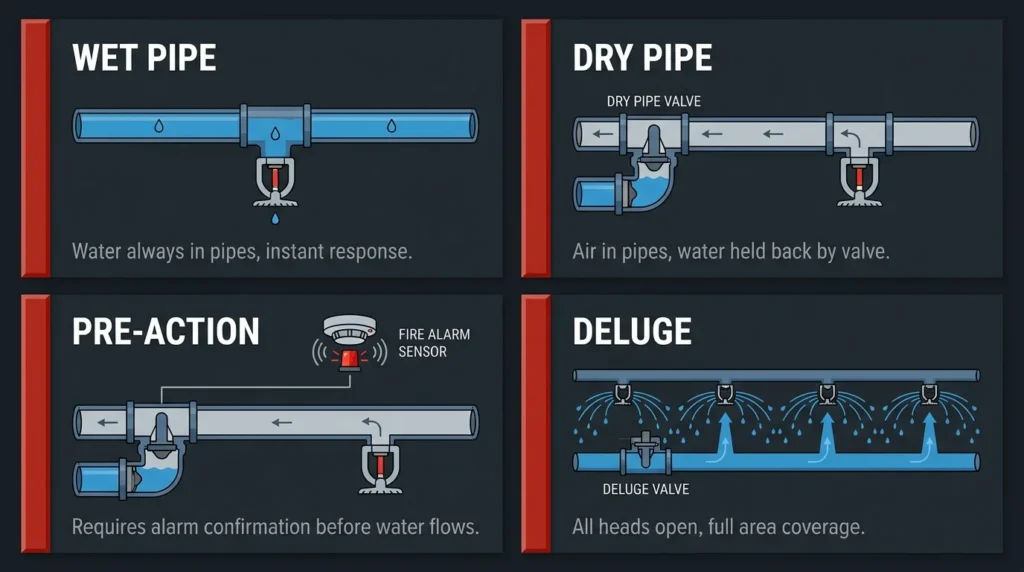
The type of system your building needs affects who should install it, how long installation takes, and what it costs.
Wet pipe systems are the most common and cost-effective. Pipes remain filled with pressurized water at all times. When a sprinkler head activates, water flows immediately. These are standard for heated buildings in moderate climates. GMW Fire Protection provides a complete guide to wet pipe sprinkler systems for building owners evaluating their options.
Dry pipe systems use pressurized air or nitrogen in the piping instead of water. When a head activates, the air releases, a valve opens, and water fills the system. Dry pipe systems are essential in unheated spaces where pipes could freeze, including parking garages, loading docks, and buildings in cold climates. They cost 30 to 50 percent more than wet pipe systems due to the additional air pressure components and more complex valve assemblies. In Alaska, where winter temperatures regularly drop well below freezing, dry pipe systems are a standard consideration for any unheated or partially heated space.
Pre-action systems combine elements of wet and dry systems. The piping is dry, but water does not flow until a separate detection event (typically a fire alarm activation) confirms a real fire. This two-step process reduces the risk of accidental water discharge, making pre-action systems common in data centers, museums, server rooms, and archives where water damage from a false activation would be catastrophic.
Deluge systems have open sprinkler heads with no individual heat-activated elements. When the system activates, water flows through every head simultaneously, drenching the entire protected area. These systems are used in high-hazard environments like chemical storage facilities, aircraft hangars, and power plants where fire can spread extremely fast.
The Fire Sprinkler Installation Process
A professional fire sprinkler installation follows a structured sequence that ensures code compliance and reliable performance.
Design and engineering. The process starts with a fire protection evaluation. Engineers assess the building’s occupancy classification, hazard level, layout, and water supply. They create detailed hydraulic calculations and system drawings specifying pipe sizes, head locations, and water flow requirements.
Permitting and plan review. Completed designs are submitted to the local Authority Having Jurisdiction for review and approval. Permitting timelines vary by jurisdiction, and your contractor should handle this process.
Material procurement and staging. Once plans are approved, the contractor orders piping, fittings, sprinkler heads, valves, and support components. Materials are staged at the job site according to the installation schedule.
Pipe installation. Crews mount hangers and supports, then run main lines and branch piping through ceilings, walls, or structural members. This is the most labor-intensive phase.
Sprinkler head and component installation. Technicians install sprinkler heads at predetermined intervals, mount control valves, connect flow switches, and wire alarm devices. For systems requiring fire pumps, pump installation happens during this phase.
Testing and inspection. The contractor performs hydrostatic pressure testing to verify system integrity, tests alarm connections, and conducts functional flow tests. The AHJ witnesses final testing and issues approval. This acceptance testing is not optional and is required before the system can be placed in service.
How Much Does Fire Sprinkler Installation Cost
Cost varies significantly based on building type, system complexity, and whether the installation is new construction or a retrofit.
Residential new construction typically runs $1 to $2 per square foot, averaging $2,000 to $6,000 for a 2,500-square-foot home. Homes with simpler layouts and newer plumbing fall toward the lower end.
Commercial new construction ranges from $1.50 to $3 per square foot. A 10,000-square-foot office might cost $20,000 to $70,000 depending on hazard classification and system complexity.
Retrofit installations cost $4 to $10 per square foot because working around existing walls, ceilings, and utilities requires significantly more labor. Historic buildings can exceed $10 per square foot.
High-hazard environments (chemical storage, manufacturing) can reach $10 to $20 per square foot due to specialized system requirements.
Planning fire sprinkler installation during initial construction rather than retrofitting later saves 40 to 60 percent on total system cost. Insurance premium discounts of 10 to 20 percent after installation can offset costs over a typical payback period of 5 to 10 years.
How to Choose the Right Fire Sprinkler Installer
Not all fire protection companies offer the same level of service. Here is what separates a reliable installer from one that may cut corners.
Verify licensing and insurance. Confirm the contractor holds a current fire protection contractor license in your state. Ask for proof of general liability and workers’ compensation insurance. A legitimate contractor provides these without hesitation.
Ask about certifications. Look for NICET-certified technicians, NFPA membership, and National Fire Sprinkler Association affiliation. Companies that invest in certifications invest in quality.
Look for design-build capability. The best fire protection companies handle both system design and installation under one roof. This eliminates coordination gaps between a design engineer and a separate installation crew. It also means one company is accountable for the entire system.
Confirm ongoing maintenance capability. Fire sprinkler systems require regular inspection and maintenance to remain code compliant and functional. Annual inspections run $100 to $300 for residential systems and $500 to $1,000 for commercial. Companies that install, inspect, and maintain systems provide continuity that matters when your system needs repair years down the line.
Evaluate experience with your building type. A contractor experienced with warehouse installations may not be the right fit for a hospital or data center. Ask about projects similar to yours in scope and complexity.
At GMW Fire Protection, our team has spent over 26 years installing, inspecting, and maintaining fire protection systems across Alaska, including remote facilities at Prudhoe Bay and Deadhorse where extreme cold and limited access make every installation more demanding. Our owner, Todd Heesch, is a licensed Professional Engineer, and our technicians are backed by UA Sprinkler Fitters Union training and IBEW Local 1547 certification. That combination of engineering oversight and union-trained field work is what it takes to build systems people can trust with their lives.
Frequently Asked Questions
Can I install my own fire sprinkler system?
In most jurisdictions, no. Fire sprinkler installation requires a state-issued contractor license, permitted plans reviewed by the local Authority Having Jurisdiction, and a final acceptance test witnessed by a fire inspector. DIY installation would not pass inspection, would void most insurance coverage, and could violate local building codes. Even in the few areas without specific licensing requirements, the hydraulic calculations and code compliance knowledge required make professional installation essential.
Do I need a plumber or a fire protection contractor?
For a single-family home with a simple system (30 or fewer heads tied to domestic water supply), a licensed plumber with fire sprinkler experience can handle the job in many states. For commercial buildings, multi-family residential over four stories, industrial facilities, or any system requiring dry pipe, pre-action, or deluge configurations, you need a licensed fire protection contractor. When in doubt, start with a fire protection contractor. They can install residential systems too, but a plumber generally cannot install commercial ones.
How long does fire sprinkler installation take?
Residential installations typically take up to three days of on-site work, though design and permitting add time before that. Small commercial projects (single-level retail) take a few weeks. Large commercial or industrial installations (multi-story buildings, warehouses, manufacturing facilities) can take several months from design through final acceptance testing. The biggest variable is usually permitting, which depends on your local jurisdiction’s review timeline.
What is the difference between wet and dry sprinkler systems?
Wet pipe systems keep water in the pipes at all times for immediate response when a head activates. Dry pipe systems hold pressurized air instead of water, with the water held back by a valve until a head opens. Dry pipe systems are necessary in unheated spaces where water could freeze in the pipes. Wet pipe systems are more common, less expensive, and faster to respond. Dry pipe systems cost 30 to 50 percent more and have a slight delay (typically 15 to 60 seconds) while air evacuates and water fills the piping.
How much does a commercial fire sprinkler system cost?
New construction commercial installations typically range from $1.50 to $3 per square foot. A 10,000-square-foot office building might cost $20,000 to $70,000. Retrofit installations in existing buildings run $4 to $10 per square foot. Costs increase for high-hazard occupancies, complex building layouts, systems requiring fire pumps, and buildings with limited water supply. Request itemized estimates from at least two licensed fire protection contractors to compare scope and pricing accurately.
How often do fire sprinkler systems need to be inspected?
NFPA 25 governs inspection, testing, and maintenance schedules for water-based fire protection systems. Visual inspections are required quarterly and annually. Five-year internal inspections involve examining the condition of piping and components. Full-flow testing of alarm devices, backflow preventers, and water supply occurs annually. GMW Fire Protection covers fire sprinkler inspection frequency requirements in detail for building owners and facility managers.
Do fire sprinkler systems come with a warranty?
Most professional fire protection contractors provide a warranty on both materials and workmanship, typically ranging from one to two years. Sprinkler heads and system components also carry manufacturer warranties. The real long-term protection comes from a maintenance agreement with your installer. Regular inspection and maintenance catches developing problems before they become system failures and keeps your warranty and insurance coverage intact.
Are fire sprinklers required in residential homes?
Requirements vary by state and municipality. The International Residential Code (IRC) has included fire sprinkler provisions for new one and two-family homes since 2009, but many states and local jurisdictions have adopted amendments that modify or remove the residential sprinkler requirement. Even where not required, the safety case is strong: NFPA data shows fire death rates drop 89 percent in homes with sprinklers. Check with your local building department or fire marshal for the requirements that apply to your specific project and location. In Alaska, GMW Fire Protection outlines current sprinkler compliance standards applicable to residential and commercial buildings.