

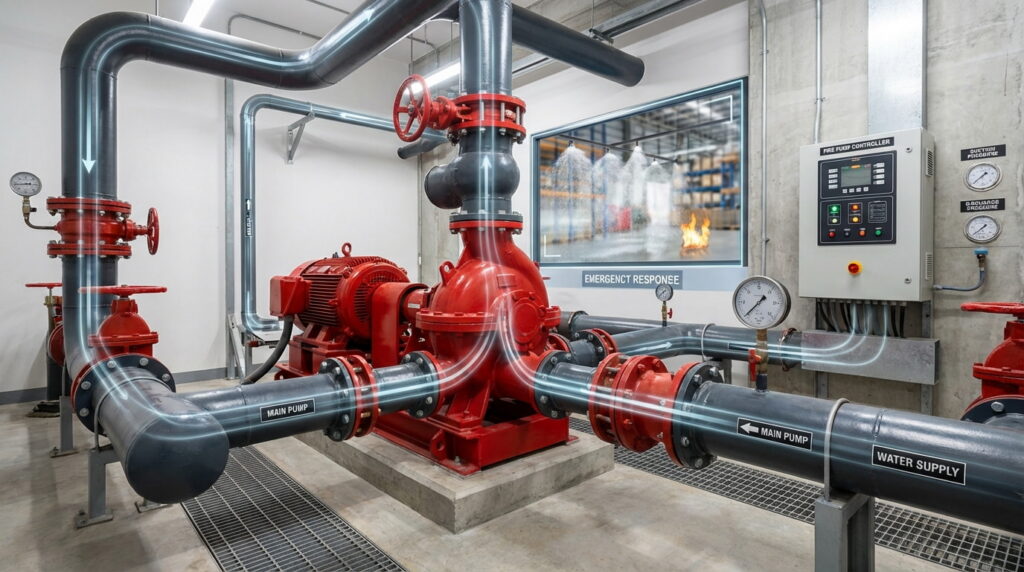
Imagine your building’s plumbing as a mountain on the top floors, water pressure from the city might barely trickle. A fire pump is like a booster that powers up the water supply when you need it most. In simple terms, a fire pump is a special pump installed in a building’s fire protection system. Its job is to increase water pressure so sprinklers and fire hoses get a strong, steady flow when a fire breaks out. This means even at the highest level of a high-rise or in a long pipe run, the water sprays out forcefully. Without a fire pump, upper-floor sprinklers might dribble instead of douse flames.
If you think of your sprinkler system as a garden hose, the fire pump is what turns the tap fully on during an emergency. Normally the pump sits ready but idle. When a fire activates a sprinkler, the pump’s sensors detect the drop in pressure and immediately start the motor. It pushes water from the source (city mains, a tank, or a well) into the pipes at much higher pressure. Fire pumps typically run on big electric motors or diesel engines for power. In other words, when a fire occurs, the pump “kicks in” to send extra water up through the system. A well-known analogy is that water is nearly incompressible: opening one sprinkler causes pressure to plunge, so the pump’s control panel senses this and cranks up the flow.
What Does a Fire Pump Do?
- Boosts Water Pressure: It takes in water from your supply and pumps it out at high pressure. For example, in very tall buildings the city water pressure alone can’t reach the top floors. The pump ensures water is sprayed forcefully through all sprinklers, even on the highest levels.
- Ensures Sufficient Flow: During large fires, firefighters often need many hoses or sprinklers at once. The fire pump delivers a large volume of water simultaneously, so each outlet has plenty of water. This means multiple hoses or sprinklers can operate without the system running dry.
- Keeps Sprinklers Running: When one or more sprinklers open, the pump automatically keeps pressure up so they keep flowing. In an activated sprinkler system, the fire pump continuously supplies the necessary pressure and flow to control or extinguish the fire.
- Provides Backup Supply: If the main water line loses pressure (due to a broken main, pump failure, or high demand elsewhere), a fire pump can pull water from an alternate source (like an on-site tank or well) to keep the system going.
These functions mean the pump is basically the heart of your fire suppression system. Fire safety standards note that fire pumps are used whenever calculations show the normal water supply isn’t enough to meet the system’s needs. By design, fire pumps are usually centrifugal pumps (they spin an impeller to force water out) that are UL- or FM-approved for fire use. In fact, codes like NFPA 20 require fire pumps in many buildings, and NFPA 25 mandates they be tested annually to ensure they work exactly as needed.
How Do Fire Pumps Work?
Inside the pump room, you’ll find the pump itself, a driver (electric motor or diesel engine), and a control panel. Under normal conditions, a tiny “jockey” pump or pressure switch keeps the system topped off, so the big pump doesn’t run for small pressure changes. But as soon as a sprinkler opens or a hose valve is used, system pressure drops sharply. The control panel senses this pressure drop and automatically starts the fire pump. The pump then pulls water from the supply and forces it into the pipes at the required pressure.
In practice, that means you don’t have to do anything – the system “knows” when to activate. When power is lost, many systems switch to a diesel-powered pump or backup generator to keep water flowing.
Fire pumps are built to be tough and reliable. Unlike ordinary pumps, they are made with non-corrosive parts so they don’t seize up, and they have specially shaped flow curves to avoid cavitation (water vapor bubbles) at low supply conditions. Every fire pump must meet strict standards: for example, it must be listed for fire service and meet NFPA 20 design criteria. In short, its job is singular maintain pressure and flow at all costs when a fire strikes.
Summary
A fire pump is the powerhouse pump that boosts water pressure in fire sprinkler and standpipe systems. Its job is to make sure water reaches everywhere it needs to, at the pressure needed, when a fire occurs. Whether pumping from a city line or a tank, a fire pump helps protect property and save lives by keeping the water flowing strong during emergencies.