
Fire sprinkler systems need to be inspected on a tiered schedule that runs from weekly all the way out to every five years, depending on which part of the system you’re talking about. Under NFPA 25, the standard that governs this across the United States, gauges on dry, pre-action, and deluge systems get checked weekly (or monthly if they’re electronically supervised), wet pipe system gauges get checked monthly, control valves and alarm devices get inspected quarterly, the full system inspection and main drain test happen annually, and an internal pipe inspection for obstructions is required every five years. That’s the short version. The longer version, and the part that actually trips up building owners, is that NFPA 25 treats inspection, testing, and maintenance as three separate activities, each with its own schedule. Missing any one of them leaves a gap in your compliance record. After more than 26 years inspecting sprinkler systems across Alaska’s commercial buildings, GMW Fire Protection has seen how often that distinction gets missed, and what it costs when it does.
Here’s the full breakdown, plus the practical stuff building owners actually need to know.
The Thing Most People Get Wrong: Inspection vs Testing vs Maintenance
Before the schedule makes sense, you need to know that NFPA 25 splits your obligations into three different categories. They get used interchangeably in conversation, but the standard treats them as separate requirements.
Inspection is a visual check. Someone looks at the system to confirm things are where they should be and in the condition they should be in. No water flows. Nothing gets taken apart. It’s the fastest of the three.
Testing is functional verification. This is where a technician actually operates something to confirm it works. Water flows during a main drain test. Alarms get triggered to confirm they signal. Valves get exercised. Testing tells you what a visual inspection never can, which is whether the system will actually perform when a fire starts.
Maintenance is the corrective and preventive work. Replacing a worn gauge, repairing a leaking valve, addressing a deficiency found during inspection or testing.
Why this matters: a building owner who says “we get inspected annually” often means the technician came out once, did a visual walkthrough, and left a tag. That may satisfy one requirement while leaving several others unmet. The quarterly and weekly obligations don’t disappear because you had an annual visit.
The Complete NFPA 25 Schedule
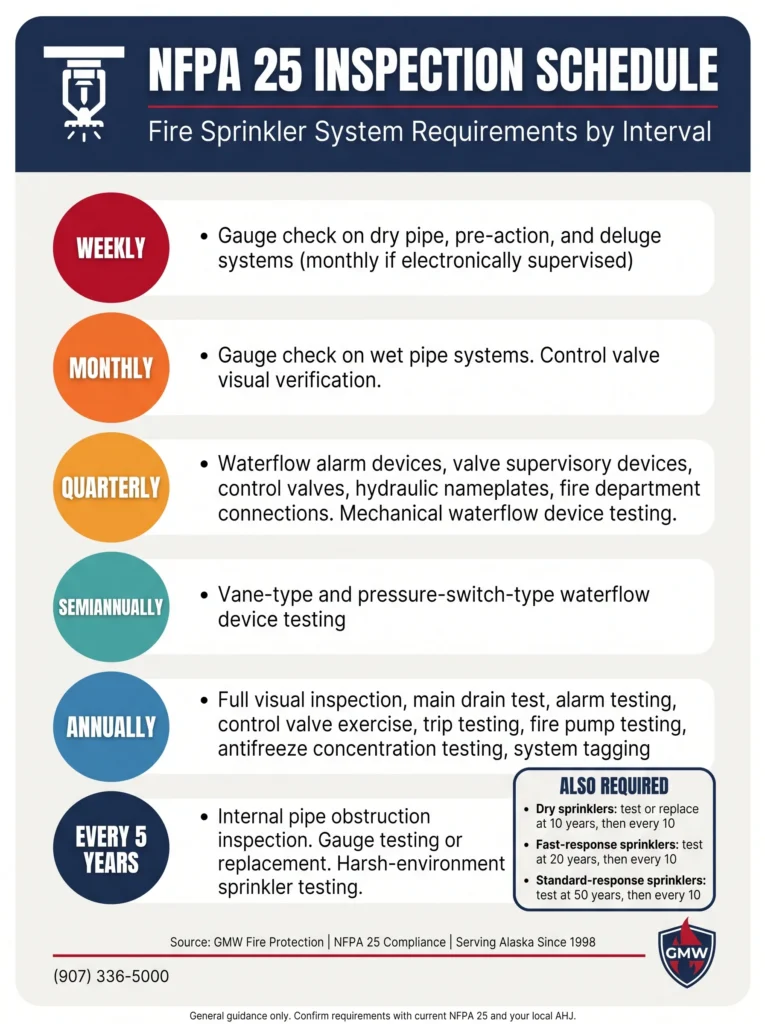
Here’s what’s required at each interval. Keep in mind that your system type, your local Authority Having Jurisdiction (AHJ), and your insurance carrier can all impose requirements beyond the baseline.
Weekly
Gauges on dry pipe, pre-action, and deluge systems need a weekly visual check to confirm normal air and water pressure. If those gauges are electronically supervised, the interval extends to monthly. This is the one requirement most often handled by in-house maintenance staff rather than an outside contractor, and it’s also the one most often forgotten entirely.
Monthly
Gauges on wet pipe systems get a monthly check. Control valves that are electronically supervised or locked also fall into a monthly visual verification in many system configurations.
Quarterly
Every three months, several components need inspection. Waterflow alarm devices, valve supervisory devices, and supervisory signal devices get inspected. Control valves get checked to confirm they’re in the correct open position, sealed or locked, accessible, and free of leaks. Hydraulic nameplates get verified as attached and legible. Fire department connections get checked for accessibility, caps in place, visible damage, and obstruction.
Quarterly is also where mechanical waterflow devices get tested.
Quarterly inspections catch the practical, real-world problems: a sprinkler head painted over during a tenant renovation, a control valve someone closed and forgot to reopen, a fire department connection blocked by a dumpster or new landscaping. These aren’t hypothetical. They’re the most common findings in the field.
Semiannually
Vane-type and pressure-switch-type waterflow devices get tested every six months.
Annually
This is the big one, and it’s where visual inspection gives way to functional testing.
The annual visit includes a full visual inspection of sprinkler heads, piping, fittings, hangers and seismic bracing, spare sprinkler stock, and information signage. It includes the main drain test, which is a full-flow test verifying the water supply can actually deliver adequate pressure and confirming there’s no significant obstruction between supply and system. Alarm devices get functionally tested. Control valves get exercised through their full range. Dry pipe, deluge, and pre-action valves get trip tested. Where a fire pump is present, annual pump testing confirms it starts automatically and delivers required flow and pressure. Antifreeze systems get their solution tested for proper concentration.
The annual is also when the system gets tagged and your compliance documentation gets generated.
Every 5 Years
An internal inspection of the sprinkler piping is required every five years to check for obstruction. A technician opens the system at designated points and examines the interior for scale, sediment, biological growth, corrosion products, or foreign material that could restrict flow or block heads from operating.
This surprises a lot of building owners who’ve never heard of it. It’s also one of the most valuable inspections, because it finds problems that are completely invisible from the outside. In older buildings with aging pipe, this inspection regularly turns up meaningful obstruction.
Gauges also get tested or replaced every five years, and sprinklers exposed to harsh environments or extra-high temperatures get tested or replaced on this interval.
Every 10 Years and Beyond
Dry sprinklers get tested or replaced at ten years, then every ten years after. Fast-response sprinklers get their first test at twenty years, then every ten years. Standard-response sprinklers get their first test at fifty years, then every ten years.
What Actually Happens During an Inspection Visit
Building owners ask us this constantly and almost nobody publishes the answer. Here’s the practical reality.
For a routine quarterly visit, a technician typically walks the building, checks the riser room, verifies valve positions and gauge readings, inspects accessible sprinkler heads, checks the fire department connection, and documents findings. On a typical commercial building this runs one to two hours. Your system stays in service the entire time and there’s no disruption to operations.
The annual visit takes longer, usually a half day or more depending on building size, because functional testing is involved. During a main drain test, water discharges, so there needs to be somewhere for it to go. During alarm testing, alarms will sound, so your monitoring company needs advance notice and building occupants should be told beforehand to avoid a false evacuation. If the system needs to be temporarily taken out of service for any portion of the work, that’s an impairment, and it triggers specific NFPA 25 requirements for notification and fire watch.
The five-year internal inspection is the most involved, since piping gets opened. This requires planning around your operations and may require a temporary system impairment.
The practical takeaway: schedule the annual and the five-year with lead time. Coordinate with your monitoring company. Notify occupants. These visits go smoothly when planned and badly when someone shows up unannounced.
Who Is Actually Responsible for Compliance?
This causes real disputes, so let’s be clear about it.
Under NFPA 25, responsibility falls on the owner or the owner’s designated representative. That’s the baseline. In practice, it gets delegated, and that’s where confusion starts.
In a single-tenant building the owner occupies, it’s straightforward. In a leased commercial property, the lease determines whether the landlord or the tenant carries the obligation, and leases vary enormously on this point. In multi-family, the property owner or management company typically holds it. In a condo or HOA setting, the association usually carries responsibility for common systems.
Here’s the part that matters: delegating the work doesn’t delegate the liability. If you own the building and your property manager missed the quarterly inspections, the AHJ and your insurance carrier are still going to look to you. Know who’s doing it, verify it’s actually being done, and keep copies of the documentation yourself rather than assuming someone else has it.
What Happens If You Miss an Inspection
The consequences are more layered than most people expect.
AHJ enforcement. Your local fire marshal can issue violations, require corrective action within a set timeframe, and in serious cases restrict occupancy. Repeat violations escalate.
Insurance exposure. This is the one that hurts most. If a fire occurs and your inspection records show gaps, your carrier will look at that closely during the claim investigation. Coverage disputes over lapsed fire protection maintenance are real and expensive.
Liability. If someone is injured in a fire and your sprinkler system wasn’t maintained to code, that documentation gap becomes central to any litigation.
Compounding system problems. Beyond the paperwork, missed inspections mean real problems go undetected. Obstruction builds, corrosion advances, closed valves stay closed. The system silently degrades until the day it’s needed.
Transaction and financing friction. Buyers, lenders, and insurers all request inspection records during due diligence. Gaps slow deals down or reprice them.
Deficiency vs Impairment: Know the Difference
These two terms get used loosely, but NFPA 25 treats them very differently and your response obligations differ.
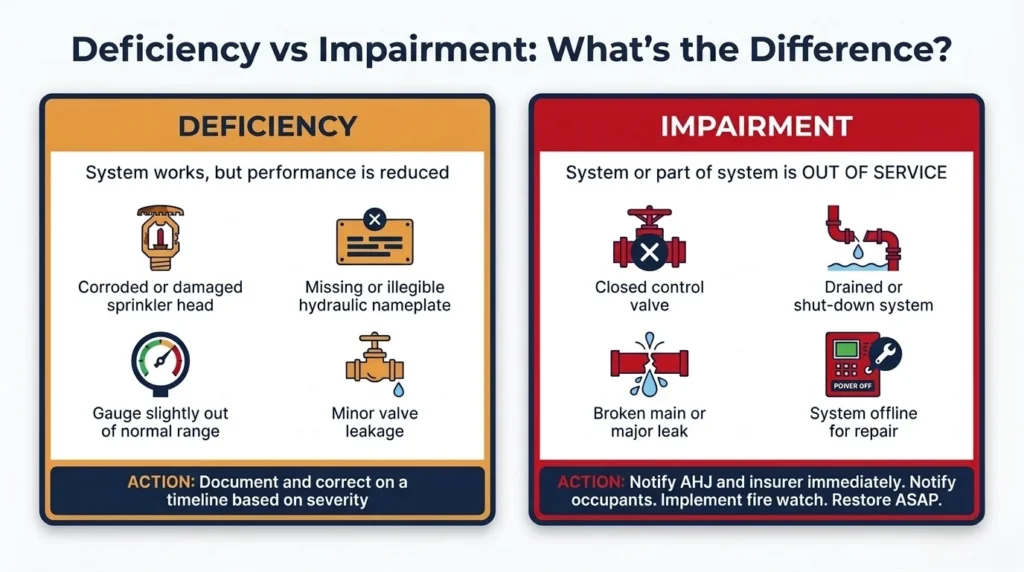
A deficiency is a condition that reduces system performance or reliability but doesn’t necessarily stop it from working. A corroded head, a missing hydraulic nameplate, a slightly out-of-range gauge. Deficiencies get documented and corrected on a reasonable timeline based on severity.
An impairment means part or all of the system is out of service. A closed control valve, a drained system, a broken main. Impairments carry immediate obligations: notify the AHJ and your insurance carrier, notify building occupants, implement a fire watch if the impairment will last beyond the allowable window, and restore the system as fast as possible.
Treating an impairment like a routine deficiency is one of the more serious compliance mistakes a building owner can make, and it’s exactly the kind of thing that surfaces badly during a claim investigation.
Cold Climate and Freeze Protection Considerations
Anywhere the temperature drops below freezing, sprinkler system inspection carries additional weight, and this is territory we know well from decades of work in Alaska.
Dry pipe and pre-action systems are common in unheated spaces precisely because water sitting in pipes will freeze and rupture them. That’s why those systems carry the weekly gauge check requirement while wet pipe systems only need monthly. Air pressure loss in a dry system is an early warning of a problem, and catching it weekly rather than monthly matters.
Antifreeze systems require annual testing of solution concentration, and this is not a formality. Concentration drifts over time, and a solution that’s too weak won’t protect against freezing while a solution that’s too strong can create other problems. Get it tested.
Cold-climate buildings also need attention to heated enclosures around risers and dry pipe valves, insulation on exposed piping, and building envelope changes that unexpectedly expose previously protected pipe to freezing temperatures. A renovation that removes a heat source near a riser can turn a compliant system into a freeze risk overnight.
For remote facilities anywhere in the country, whether that’s a rural industrial site, a mining operation, or a facility only reachable seasonally, inspection scheduling has to account for access windows. Planning the annual around when a technician can actually get there is part of a working compliance program.
What Drives the Cost of Sprinkler Inspection
We won’t quote specific prices here since they vary widely by market and system, but here’s what actually determines what you’ll pay.
System size and complexity is the biggest driver. Number of risers, number of sprinkler heads, and total square footage all matter. System type matters too, since dry, pre-action, and deluge systems require more work than a straightforward wet pipe system. Buildings with fire pumps, standpipes, or backflow preventers carry additional testing scope. Building accessibility affects labor time, since concealed heads, high ceilings requiring lifts, and restricted-access areas all take longer. Frequency and bundling matter, since a full-year service agreement covering all intervals usually costs less than booking each visit separately. And travel matters for remote locations.
The one thing worth saying plainly: the cheapest inspection is rarely the best value. An inspection that misses a problem costs far more than the money it saved.
Choosing a Qualified Inspection Provider
Not every company that offers sprinkler inspection is equally qualified. A few things worth verifying.
Ask about technician certification. NICET certification in Inspection and Testing of Water-Based Systems is the industry benchmark, and reputable companies will tell you their technicians’ certification levels without hesitation. Ask about state licensing, since requirements vary but most states license fire protection contractors. Ask what documentation you’ll receive and in what format, because inspection reports that satisfy an AHJ and an insurance carrier need specific detail. Ask how deficiencies get communicated and tracked. And ask whether they’ll manage your compliance calendar, since the most common failure isn’t a bad inspection, it’s a forgotten interval.
Bottom Line
Fire sprinkler inspection isn’t a single annual event. It’s a tiered schedule under NFPA 25 running from weekly gauge checks through the five-year internal pipe inspection, with inspection, testing, and maintenance treated as three distinct obligations. Missing an interval creates a documented gap that shows up when it matters most: during an AHJ review, an insurance claim, or a property transaction.
The building owners who stay compliant aren’t the ones who care most. They’re the ones who know their schedule, know who’s responsible, keep their own copies of the documentation, and work with a provider who tracks intervals so nothing gets missed. If you’re not sure where your building stands, a review of your current inspection records is the right place to start.
Frequently Asked Questions
Is an annual inspection enough for a fire sprinkler system?
No. NFPA 25 requires inspections and tests at multiple intervals, including weekly or monthly gauge checks, quarterly inspections of valves and alarm devices, semiannual testing of certain waterflow devices, the full annual inspection and testing, and a five-year internal pipe inspection. An annual visit alone leaves several requirements unmet.
Who is responsible for fire sprinkler inspections, the landlord or the tenant?
NFPA 25 places responsibility on the building owner or the owner’s designated representative. In leased properties, the lease agreement typically determines whether the landlord or tenant handles the work. Delegating the task doesn’t remove the owner’s ultimate liability, so owners should verify inspections are happening and keep their own copies of the documentation.
What’s the difference between a deficiency and an impairment?
A deficiency is a condition that reduces system performance or reliability without necessarily taking it out of service, and it gets corrected on a timeline based on severity. An impairment means part or all of the system is out of service, and it triggers immediate obligations including notifying the AHJ and insurance carrier, notifying occupants, and implementing a fire watch if the impairment extends beyond the allowable window.
How long does a fire sprinkler inspection take?
A routine quarterly inspection on a typical commercial building usually takes one to two hours with no disruption to operations. The annual inspection and testing generally takes a half day or longer depending on building size, since functional testing is involved. The five-year internal pipe inspection takes longer still and requires advance planning.