

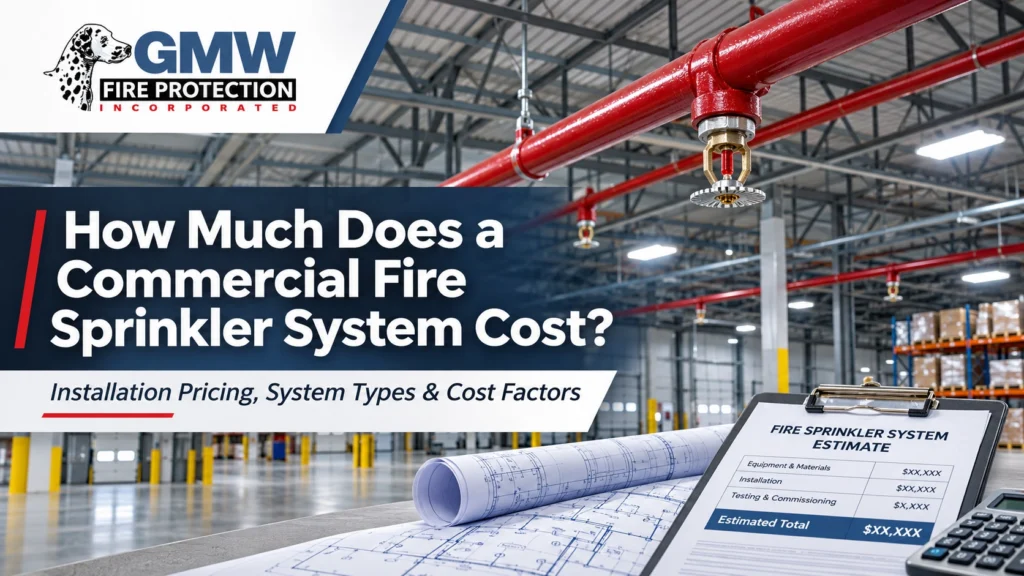
Most commercial fire sprinkler systems cost somewhere between $1.00 and $7.00 per square foot across the United States. New construction sits at the lower end — $1.00 to $3.00 per square foot — while retrofitting an existing building jumps to $2.00 to $7.00 per square foot. Go with a specialized system like pre-action or deluge, and you’re looking at $15.00+ per square foot.
Those per-square-foot numbers are a starting point, though. What you’ll actually pay depends on the system type, your building’s size and layout, local fire codes, and whether you’re building from scratch or retrofitting. To put real dollars on it: a 20,000-square-foot commercial building might run $20,000 to $60,000 for a new wet pipe system. A 100,000-square-foot warehouse retrofit? That could hit $300,000 to $700,000.
We’ll break down every cost you’re going to face below — the sprinkler heads, the fire pump nobody warned you about, permits, engineering fees, and the ongoing maintenance that keeps the system legal and functional.
Quick Cost Overview
Typical commercial fire sprinkler system costs across the U.S. at a glance:
| Project Type | Cost Per Square Foot | 20,000 Sq Ft Example |
|---|---|---|
| New construction (wet pipe) | $1.00 – $3.00 | $20,000 – $60,000 |
| Retrofit (wet pipe) | $2.00 – $7.00 | $40,000 – $140,000 |
| Dry pipe system | $3.00 – $9.00 | $60,000 – $180,000 |
| Pre-action system | $4.00 – $15.00+ | $80,000 – $300,000+ |
| Deluge system | $5.00 – $8.00 | $100,000 – $160,000 |
| High-rise building | $4.00 – $8.00 | $80,000 – $160,000 |
| Historic building retrofit | $10.00 – $20.00+ | $200,000 – $400,000+ |
These numbers cover equipment, labor, and basic installation. They don’t include fire pumps, water storage tanks, or engineering fees — all of which we’ll cover below. For exact pricing on your specific project, reach out to a licensed fire protection contractor who can assess your building in person.
Cost by Sprinkler System Type
The type of fire sprinkler system you need is the single biggest factor in what you’ll pay. Four main types exist, and each one comes with a very different price tag.
Wet Pipe Sprinkler Systems
Cost: $1.00 – $3.00/sq ft (new construction) | $2.00 – $7.00/sq ft (retrofit)
Wet pipe is what most people picture when they think “fire sprinkler.” Water sits in the pipes around the clock, ready to flow the instant a head activates from heat. No delay. No secondary trigger. Just immediate response.
That simplicity is also why it’s the cheapest option. Fewer components, no air compressor, no nitrogen system — and straightforward installation means lower labor costs too.
NFPA data backs up the performance: wet pipe systems operate successfully in 92% of fires where sprinklers are present. And 89% of the time, just one or two heads are enough to control the fire before it spreads. That’s a remarkable track record for the least expensive system on the market.
You’ll find wet pipe in offices, retail, hotels, hospitals — basically any building that stays above 40°F year-round.
Best for: Climate-controlled commercial buildings, offices, hotels, retail, healthcare facilities.
Dry Pipe Sprinkler Systems
Cost: $3.00 – $9.00 per square foot
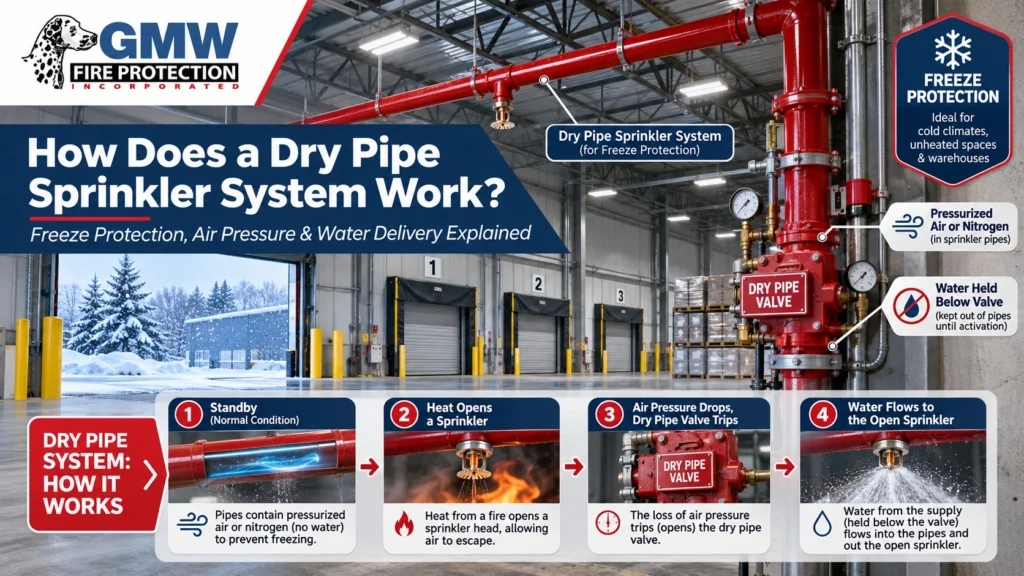
Dry pipe flips the script. Instead of water, the pipes hold pressurized air or nitrogen. When a head activates, the air pressure drops, a valve opens, and then water fills the pipes and discharges. The whole point? Preventing frozen and burst pipes in spaces that get cold.
You’re paying more because the system is more complex. A dry pipe valve, an air compressor or nitrogen generator, more intricate piping — and installation takes longer because the whole setup needs more testing and calibration.
One trade-off worth knowing: NFPA data shows dry pipe systems have an 80% operational rate in fires, compared to 92% for wet pipe. That gap exists partly because the air-to-water delay gives fires a head start.
In Alaska, though, dry pipe isn’t a choice. It’s a code requirement for any unheated space — parking garages, loading docks, warehouses without climate control. Budget for the higher per-square-foot cost as your baseline, not a maybe.
Best for: Unheated warehouses, parking garages, loading docks, cold storage, and any space exposed to freezing temperatures.
Pre-Action Sprinkler Systems
Cost: $4.00 – $15.00+ per square foot
Think of pre-action as a “double-check” system. The pipes stay dry until a separate detection system — smoke or heat detectors — confirms there’s actually a fire. Only then does the valve open and fill the pipes. And even after that, a sprinkler head still has to activate from heat before water discharges.
Why pay the premium? Because in a data center or server room, accidental water discharge from a bumped sprinkler head could cause more damage than the fire itself. Same goes for museums, archives, telecom facilities, and cold storage with high-value inventory.
The price reflects that dual detection system, more sophisticated valving, and the specialized engineering behind it. Expect higher maintenance costs over the system’s life, too — more components means more to inspect and test.
Best for: Data centers, server rooms, museums, archives, libraries, telecom facilities.
Deluge Sprinkler Systems
Cost: $5.00 – $8.00 per square foot
Deluge is the aggressive option. Every sprinkler head in the zone is open — no heat-sensitive elements at all. When the detection system triggers, all of them discharge simultaneously. The entire area floods with water.
It sounds extreme, and it is. Deluge exists for environments where fire spreads so fast that waiting for individual heads to pop isn’t good enough. Chemical plants, aircraft hangars, power generation facilities, fuel loading areas — places where flammable materials can ignite and engulf a space in seconds.
The cost is higher than wet pipe due to specialized open heads, larger-diameter piping for high-volume water flow, and the robust detection system that controls when the valve opens.
Best for: Chemical storage, aircraft hangars, power plants, industrial facilities handling flammable materials.
Cost by Building Type and Size
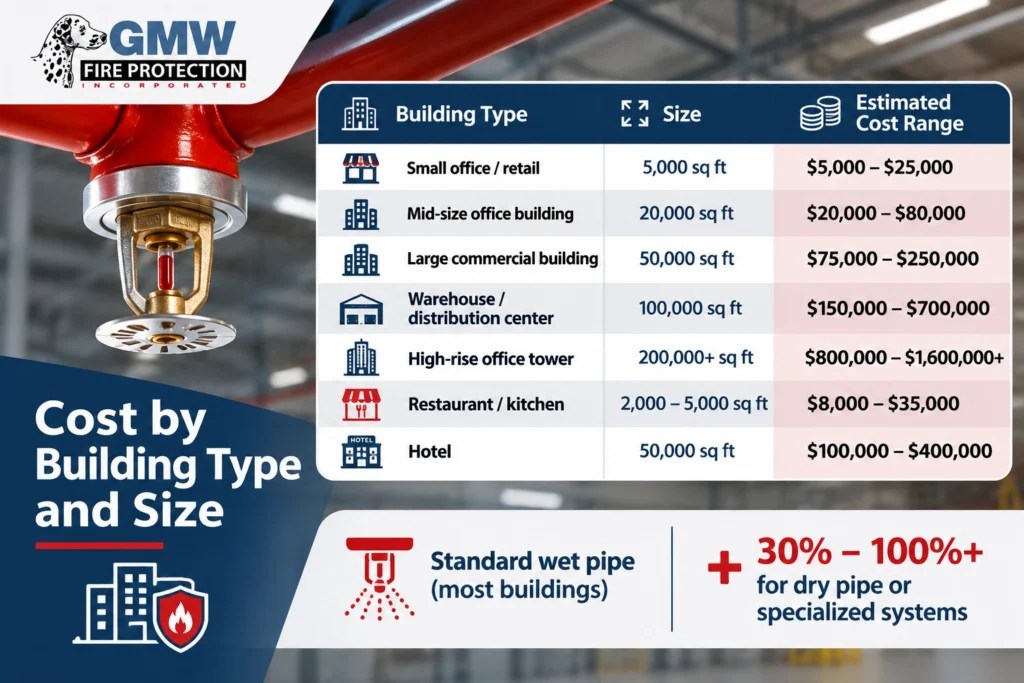
What you’re protecting matters just as much as how you’re protecting it. A small retail space and a 100,000-square-foot warehouse are completely different projects, and the price reflects that.
| Building Type | Size | Estimated Cost Range |
|---|---|---|
| Small office / retail | 5,000 sq ft | $5,000 – $25,000 |
| Mid-size office building | 20,000 sq ft | $20,000 – $80,000 |
| Large commercial building | 50,000 sq ft | $75,000 – $250,000 |
| Warehouse / distribution center | 100,000 sq ft | $150,000 – $700,000 |
| High-rise office tower | 200,000+ sq ft | $800,000 – $1,600,000+ |
| Restaurant / kitchen | 2,000 – 5,000 sq ft | $8,000 – $35,000 |
| Hotel | 50,000 sq ft | $100,000 – $400,000 |
These assume standard wet pipe for most building types. Dry pipe or specialized systems add 30% to 100%+ on top. Restaurants cost more per square foot because commercial kitchens usually need a separate fire suppression system in addition to the building’s sprinkler system — that’s two systems, not one.
Why the Range Is So Wide
Same square footage, wildly different price. A 20,000-square-foot building could cost $20,000 or $80,000, and the footprint has almost nothing to do with it. Three things drive that gap:
Hazard classification is number one. NFPA 13 sorts occupancies into light hazard (offices, churches, hotels), ordinary hazard (retail, warehouses, manufacturing), and extra hazard (chemical plants, woodworking shops, paint storage). Higher hazard means more sprinkler heads per square foot, larger pipes, and higher water flow rates. All of that adds up fast.
Ceiling height is next. A 10-foot ceiling office is a simple, cheap install. A 30-foot warehouse? You need higher-pressure systems and potentially larger-diameter piping to push water that high with adequate coverage.
Layout complexity rounds it out. Multiple floors, partitioned spaces, drop ceilings, tight corridors — every one of those means more piping and more heads.
New Construction vs. Retrofit
This comparison matters more than most people realize.
When you’re building new, fire sprinkler installation happens alongside your mechanical systems. Pipes go in before walls and ceilings close up. The sprinkler contractor coordinates with your plumber, electrician, and HVAC crew. It’s efficient, predictable, and relatively cheap.
Retrofitting? Completely different animal. You’re opening up walls, ceilings, and floors to run new piping. You’re working around existing mechanical, electrical, and plumbing systems that weren’t designed with sprinklers in mind. Your tenants might need to relocate during construction. And your building’s water supply might not cut it without a booster pump or dedicated storage tank.
The numbers on a 20,000-square-foot building tell the story:
| Cost Category | New Construction | Retrofit |
|---|---|---|
| Sprinkler system (installed) | $20,000 – $60,000 | $40,000 – $140,000 |
| Engineering and design | $2,000 – $6,000 | $4,000 – $12,000 |
| Permits | $500 – $2,000 | $1,000 – $5,000 |
| Construction/patching | Included in build | $5,000 – $30,000 |
| Estimated total | $22,500 – $68,000 | $50,000 – $187,000 |
Bottom line: if you’re planning a new building, include sprinklers in the original design. Even if your jurisdiction doesn’t mandate them for your building type, you’ll lock in the lower cost and dodge the disruption of a future retrofit. It’s one of the easiest long-term savings decisions you can make.
Additional Costs Most People Don’t Budget For
The per-square-foot figures above cover the core system — piping, heads, valves, and labor. But there are several other line items that can add real money to your project. And if you don’t know about them going in, they’ll show up as surprises on the final invoice.
Fire Pump — $15,000 – $75,000
When your building’s municipal water pressure can’t deliver the flow rate and pressure your sprinkler system demands, you need a fire pump. This is common in high-rises, large warehouses, and buildings far from municipal water mains.
A small electric fire pump for a mid-rise building might run $15,000 to $25,000 installed. Diesel fire pumps for large commercial or industrial facilities? $40,000 to $75,000.
Water Storage Tank — $60,000 – $250,000+
Rural locations, remote sites, and buildings with very high flow demands sometimes need a dedicated fire water storage tank. It’s a big-ticket item — and it’s more common than you’d think in industrial settings and remote locations, including plenty of project sites across Alaska.
Backflow Prevention — $1,000 – $5,000
Most jurisdictions require a backflow prevention device to keep stagnant sprinkler water out of your potable water supply. It’s a code requirement, not something you can skip.
Engineering and Design — $0.10 – $0.30/sq ft
Your fire protection engineer designs the system based on NFPA standards, your building’s hazard classification, water supply analysis, and local codes. Don’t cut corners here. A properly engineered system works when it counts and avoids expensive redesigns when the inspector shows up.
Permits and Plan Review — $500 – $5,000
Permit fees swing wildly depending on jurisdiction. Big cities with complex review processes charge more, and some require third-party plan review on top of the standard filing.
Seismic Bracing — $0.25 – $1.00+/sq ft
In seismically active regions, your sprinkler piping needs bracing to survive an earthquake. Alaska sits in the highest seismic zones in the country, so this isn’t a “maybe” — it’s a standard line item on virtually every Alaskan fire sprinkler project. Buildings in low-seismic areas don’t face this cost at all.
General Contractor Coordination (Retrofits) — $5,000 – $30,000+
Somebody has to handle ceiling removal and replacement, drywall repair, painting, and cleanup after the sprinkler crew wraps up. That somebody is usually a general contractor, and their bill belongs in your sprinkler budget — even though it’s not part of the sprinkler contract itself.
What Drives Fire Sprinkler Costs Up or Down
Knowing the cost drivers helps you predict where your project falls within those wide ranges.
Factors That Push Costs Up
Building age and condition. Older buildings with outdated plumbing, limited access points, and asbestos in the ceilings push retrofit costs toward the top of the range — and sometimes beyond it.
Working around occupants. Retrofitting a building while people are still using it means phased construction, off-hours work, and constant coordination. That’s more expensive than working in an empty shell.
High-hazard occupancies. Chemical plants, woodworking shops, paint storage — NFPA’s extra hazard classifications require more heads, larger pipes, and higher water flow rates. You’ll pay significantly more per square foot than an office building.
Multiple stories. Each additional floor adds piping runs, risers, and water pressure demands. High-rise buildings (75+ feet) face the most complex and expensive installations.
Remote locations. Shipping materials to Fairbanks, the North Slope, or rural Alaskan communities costs real money. Labor rates in those areas are higher too, thanks to travel time and a smaller local workforce.
Aesthetic finishes. Concealed heads, custom cover plates, and decorative finishes for hotel lobbies or high-end offices add $3 to $10+ per head. They look great. They also cost accordingly.
Factors That Bring Costs Down
Building sprinklers into new construction. Always cheaper. Always.
Simple, open floor plans. Warehouses and big-box retail with high ceilings and minimal walls are the cheapest buildings to protect per square foot.
Strong municipal water pressure. Good water pressure means no fire pump — and that removes a $15,000 to $75,000 line item from your budget.
Multipurpose piping. Where code allows it, combining your domestic water supply with the sprinkler system cuts piping costs. Most common in smaller buildings under NFPA 13R or 13D.
Getting competitive bids. Three or more quotes from licensed fire protection contractors consistently beats single-source pricing. It’s not even close.
Alaska and Cold-Climate Cost Considerations
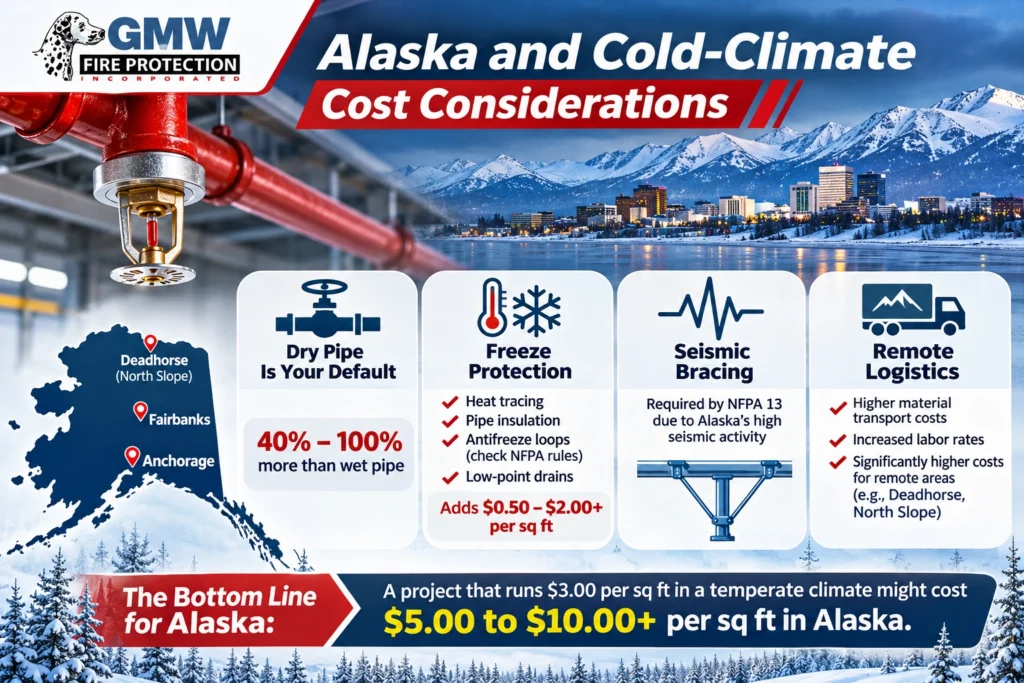
If your building is in Alaska or another cold-climate state, plan on spending more than the national averages above. Not a little more — meaningfully more.
Dry Pipe Is Your Default
In the lower 48, wet pipe dominates because most commercial spaces stay warm. In Alaska, any space that can’t guarantee temperatures above 40°F year-round — parking structures, loading docks, storage buildings, seasonal facilities, most warehouses — needs dry pipe to avoid frozen and burst pipes.
Dry pipe runs 40% to 100% more than wet pipe. That’s not a contingency line item. In Alaska, it’s your baseline.
Freeze Protection Adds Up
Even buildings running wet pipe need extra protection against Alaska’s cold:
- Heat tracing on pipes near exterior walls or running through unheated spaces
- Insulation on all piping in freeze-prone areas
- Antifreeze loops in small sections where heat tracing isn’t practical (note: NFPA has tightened antifreeze rules due to fire concerns — check current requirements)
- Low-point drains on dry systems to stop condensation from freezing and blocking pipes
Expect these measures to add $0.50 to $2.00+ per square foot to your total.
Seismic Bracing Isn’t Optional
Alaska has the highest seismic activity of any state in the country. Your sprinkler piping must be braced per NFPA 13 seismic requirements — adding material, labor, and engineering costs that projects in low-seismic regions simply don’t have.
Remote Logistics Hit Hard
Getting materials to Fairbanks costs more than Anchorage. Getting them to Deadhorse costs a lot more than Fairbanks. North Slope projects face some of the highest logistics costs anywhere in the U.S., and labor rates in remote Alaskan communities reflect the travel time and limited local availability.
What This Means for Your Budget
A project that runs $3.00 per square foot in a temperate climate might cost $5.00 to $10.00+ in Alaska after you factor in dry pipe, freeze protection, seismic bracing, and remote logistics.
For projects anywhere in Alaska — Anchorage, Fairbanks, the North Slope, or anywhere in between — get a site-specific quote from a contractor who’s actually done cold-climate work. It makes a difference.
Ongoing Maintenance and Inspection Costs
Installing a fire sprinkler system isn’t a one-time expense. Walk away after installation and skip the maintenance, and you’ll eventually face fines, insurance problems, or a system that doesn’t work when you need it most.
NFPA 25 — the Standard for Inspection, Testing, and Maintenance of Water-Based Fire Protection Systems — lays out exactly what’s required and when. Your local fire marshal will check.
What Annual Maintenance Typically Costs
| Building Size | Annual Inspection Cost | Quarterly Inspection Cost |
|---|---|---|
| Small commercial (under 10,000 sq ft) | $350 – $1,000 | $250 – $600 per visit |
| Mid-size commercial (10,000 – 50,000 sq ft) | $1,000 – $4,000 | $500 – $1,500 per visit |
| Large commercial (50,000 – 100,000 sq ft) | $3,000 – $8,000 | $1,000 – $3,000 per visit |
| Industrial / high-rise (100,000+ sq ft) | $5,000 – $13,000+ | $2,000 – $5,000+ per visit |
The NFPA 25 Testing Timeline
The inspection schedule required by NFPA 25 goes well beyond an annual checkup:
- Weekly/Monthly: Gauge readings, valve positions, alarm devices
- Quarterly: Water flow alarm tests, valve inspections, fire pump tests
- Annually: Full system inspection — every sprinkler head, all piping, hangers, and bracing
- 5-Year: Internal pipe inspection and obstruction investigation
- 10-Year: Full system flush, plus sprinkler head testing or replacement for older heads
Skip any of these, and you’re rolling the dice. Failing a fire sprinkler inspection can mean fines, jacked-up insurance premiums, or an order to vacate until you fix the deficiencies. Routine maintenance is always cheaper than emergency repairs after something fails.
Are Fire Sprinklers Worth the Investment?
Let’s talk return on investment — because fire sprinklers are one of the few building systems that actually pay for themselves.
Insurance Savings
Most commercial property insurers cut premiums by 10% to 20% on the fire portion of your policy for fully sprinklered buildings. On a building paying $15,000 a year in fire insurance, that’s $1,500 to $3,000 back in your pocket — every single year.
Over 20 years, those savings alone add up to $30,000 to $60,000. That offsets a big chunk of the original install.
The NFPA Numbers Speak for Themselves
- Fire sprinklers work in 96% of fires where they’re present
- Properties with sprinklers see 83% fewer fire deaths
- Sprinklered buildings suffer 34% to 77% less property damage per fire
- Fires stay contained to the room of origin 95% of the time in sprinklered buildings
That last stat is the one that matters financially. A fire that stays in one room is an insurance claim and a cleanup. A fire that spreads through the building is a total loss — and potentially a business that never reopens.
Running the Math
Take a 20,000-square-foot commercial building with a $40,000 wet pipe system:
- Annual insurance savings: $1,500 – $3,000
- 10-year savings: $15,000 – $30,000
- 20-year savings: $30,000 – $60,000
- Average avoided commercial fire loss (NFPA): $120,000+
The system pays for itself through insurance savings alone in roughly 13 to 25 years. And that math doesn’t account for even one avoided fire — which, statistically, most commercial buildings will face at least once over a 40-year lifespan.
Which NFPA Standard Applies to Your Building?
The standard your building falls under affects the design, and the design affects the price. Quick breakdown:
| Standard | Applies To | Cost Impact |
|---|---|---|
| NFPA 13 | Commercial and industrial buildings | Full commercial design — highest requirements and cost |
| NFPA 13R | Residential buildings up to 4 stories | Reduced requirements in some areas — lower cost |
| NFPA 13D | One- and two-family dwellings | Simplest design — lowest cost, residential only |
Most commercial buildings fall under NFPA 13 — the most comprehensive (and most expensive) standard. Mixed-use buildings with residential floors above four stories also need NFPA 13 throughout.
This matters when you’re comparing bids. A contractor quoting to NFPA 13R is pricing a fundamentally different system than one quoting to NFPA 13. If you don’t catch that mismatch during bid review, you’ll make a bad decision based on numbers that aren’t comparable.
How to Get an Accurate Quote
Every building is different, which is why the ranges in this guide are wide. To narrow them down for your project:
Know your building inside and out. Square footage, floor count, ceiling heights, construction type, current water supply info. The more detail you hand your contractor upfront, the tighter the estimate.
Figure out your hazard classification. Your contractor or engineer will confirm it, but knowing ahead of time whether you’re light, ordinary, or extra hazard sets the right expectations from the start.
Get at least three quotes. Always. Request proposals from three or more licensed fire protection contractors and make sure everyone’s bidding to the same NFPA standard and scope.
Clarify what’s included — and what isn’t. Does the quote cover engineering? Permits? Fire pump? Backflow prevention? Post-installation inspection? If those are separate line items, you need to know before you sign.
Ask about maintenance contracts. A lower installation bid without a maintenance plan can cost more over time than a slightly higher bid that bundles ongoing service. Think lifecycle cost, not just day-one price.
Frequently Asked Questions
How much does a single fire sprinkler head cost to install?
The head itself runs $5 to $30 depending on type — pendant, upright, sidewall, or concealed. Fully installed with piping, fittings, and labor, you’re typically looking at $155 to $400 per head. How many your building needs depends on the hazard classification, ceiling height, and layout per NFPA 13.
Do fire sprinklers increase property value?
They do. Sprinklered buildings command higher lease rates and sale prices because tenants and buyers know they’re getting lower insurance, better safety, and less business interruption risk. Some occupancy types and building uses aren’t even allowed without sprinklers — so the system opens doors that wouldn’t otherwise be available.
How long does installation take?
For new construction, figure 2 to 4 weeks on a 20,000-square-foot project. Retrofits take longer — usually 4 to 12 weeks — because you’re threading pipe through existing structures and coordinating around other trades and building occupants.
Can you retrofit sprinklers into an existing building?
Yes, and it’s done all the time. Retrofits cost more ($2.00 to $7.00 per square foot vs. $1.00 to $3.00 for new construction), but once the system’s in, the protection is identical. Don’t let the higher cost talk you out of it if your building needs protection.
How long do fire sprinkler systems last?
40 to 50+ years with proper maintenance. The piping and valves last the longest. Sprinkler heads need testing after 20 years (50 years for certain types per NFPA 25), and any that fail get replaced. The key word is “proper maintenance” — skip the inspections, and that lifespan shrinks.
Do all the sprinkler heads go off at once?
No. In wet pipe, dry pipe, and pre-action systems, each head activates independently when the temperature at that specific head reaches its trigger point — usually 155°F to 165°F. In most fires, one or two heads handle the job. The only exception is deluge systems, where every head in the zone fires simultaneously by design.
Are fire sprinklers required by code?
It depends on your jurisdiction, building type, and size. The International Building Code generally requires sprinklers in buildings with certain occupancy types, buildings over 5,000 square feet (depending on use), and all high-rises. Your local authority having jurisdiction (AHJ) may have stricter requirements on top of that. Your fire marshal or a licensed fire protection contractor can tell you exactly what your building needs.
How much water damage do sprinklers actually cause?
A lot less than the alternative. One sprinkler head puts out roughly 15 to 25 gallons per minute. A fire department hose delivers 100 to 250 gallons per minute — and by the time they arrive, the fire’s had time to grow. Sprinklers activate early, only the heads near the fire go off, and total water usage is a fraction of what firefighting operations use. The water damage from sprinklers is almost always less than the fire damage would’ve been without them.
Get a Quote for Your Building
Every number in this guide reflects typical industry pricing across the United States. What you’ll actually pay comes down to your building, your codes, your local labor market, and the system your occupancy requires.
The only way to get a real number is a site-specific quote from a licensed fire protection contractor who can walk your building, test your water supply, and engineer a system to NFPA standards.
For buildings anywhere in Alaska — Anchorage, Fairbanks, the North Slope, or anywhere in between — GMW Fire Protection has been designing, installing, and maintaining fire sprinkler systems for over 25 years. Request a free project consultation or call us directly:
- Anchorage: (907) 336-5000
- Fairbanks: (907) 450-6590
- Deadhorse: (907) 748-7960