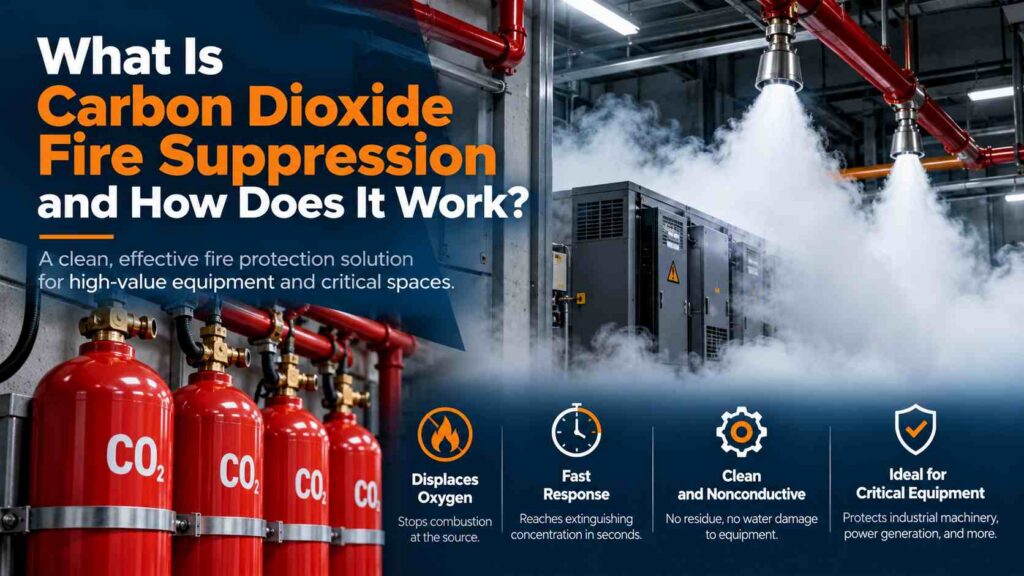
Carbon dioxide fire suppression is a gaseous fire protection method that extinguishes flames by displacing oxygen in a protected space. A CO2 system stores liquid carbon dioxide under pressure in steel cylinders, then releases it through a piping network and discharge nozzles when detectors sense a fire. The gas floods the area, drops the oxygen concentration below the level combustion requires, and smothers the fire without leaving residue or damaging equipment. These systems protect industrial machinery, power generation equipment, marine engine rooms, and other spaces where water or foam would cause more harm than the fire itself.
How Carbon Dioxide Puts Out a Fire
Every fire needs three things: fuel, heat, and oxygen. Remove any one and the fire dies. Carbon dioxide attacks the oxygen side.
When the system discharges, CO2 floods the space and displaces breathable air. The gas is roughly 50 percent heavier than air, so it settles over the fire and forms a dense blanket that cuts off the oxygen supply. For surface fires involving flammable liquids or gases, the system brings CO2 concentration to around 34 percent within seconds. Deep seated fires in materials like paper, cotton, or wood need higher concentrations, typically 65 to 75 percent, because smoldering materials can reignite if oxygen returns too quickly.
Once the system reaches the target concentration, it holds that level for a minimum of 10 minutes to prevent reignition while hot surfaces and fuel sources cool.
CO2 also provides a secondary cooling effect during discharge. As pressurized liquid converts to gas, the rapid expansion absorbs heat from the surrounding atmosphere. This is not the primary extinguishing mechanism, but it contributes to bringing temperatures down in the protected space.
Total Flooding vs Local Application
CO2 systems come in two fundamental configurations, and choosing the wrong one for your hazard is a costly mistake.
Total Flooding
Total flooding systems protect an entire enclosed room or compartment. The system calculates the volume of the space, accounts for leakage, and stores enough CO2 to reach the required concentration throughout the enclosure. Generator rooms, switchgear rooms, and turbine enclosures typically use total flooding.
For total flooding to work, the enclosure needs to hold concentration for the required hold time. Gaps around doors, cable penetrations, ventilation openings, and unsealed pipe runs allow CO2 to escape and oxygen to re-enter. Part of the design process involves evaluating enclosure integrity and specifying what needs to be sealed before installation.
Local Application
Local application targets a specific piece of equipment or hazard area rather than flooding the entire room. CO2 is the only gaseous suppression agent tested and validated for localized discharge. That makes it the go-to choice for open or semi-enclosed hazards like dip tanks, quench tanks, spray booths, printing presses, and hydraulic systems.
Nozzle placement, angle, and spacing are engineered to maintain effective concentration around the equipment without flooding the full room.
High Pressure vs Low Pressure Storage
How you store the CO2 affects system cost, footprint, and which applications the system can serve.
High Pressure Systems
High pressure systems store CO2 as a liquid in individual cylinders at ambient temperature and roughly 850 psi. Standard cylinder sizes are 50, 75, and 100 pounds. Multiple cylinders are manifolded together on a rack and connected to the piping network through a common header.
The cylinders are compact, do not require refrigeration, and can be located close to the protected space. Most carbon dioxide suppression installations in commercial and light industrial settings use high pressure storage.
Low Pressure Systems
Low pressure systems store CO2 in a large refrigerated tank at 0 degrees Fahrenheit and approximately 300 psi. A single tank can hold several tons of agent, making low pressure storage more practical when the system needs to protect multiple hazards or very large spaces.
Power plants, large manufacturing facilities, and marine applications often use low pressure systems because the volume of CO2 required would demand dozens of individual cylinders. The refrigerated tank delivers a more uniform discharge, but requires a dedicated equipment room with power for the refrigeration unit.
Components of a CO2 Fire Suppression System
A CO2 system is an integrated assembly of storage, distribution, detection, and safety components that all need to work together.
Storage includes CO2 cylinders or a refrigerated tank, pressure gauges, liquid level indicators, and cylinder racks with restraints.
Distribution covers release valves (electrically or pneumatically actuated), selector valves that route agent to specific hazard zones, the piping network (schedule 40 or 80 steel pipe, hydraulically calculated), and discharge nozzles engineered for specific coverage patterns.
Detection and control includes smoke, heat, or flame detectors feeding into a fire alarm control panel. Many systems use cross-zone detection logic, requiring two independent detectors to confirm a fire before triggering release. This reduces false discharges. Manual pull stations let personnel activate the system, and abort buttons outside the protected space allow someone to stop a discharge if evacuation is incomplete.
Safety devices include audible alarms (horns and pneumatic sirens), visual alarms (strobes), warning signs at every entry point, and automatic interlocks that shut down ventilation, close fire dampers, and isolate electrical equipment before discharge.
Where CO2 Fire Suppression Systems Are Used
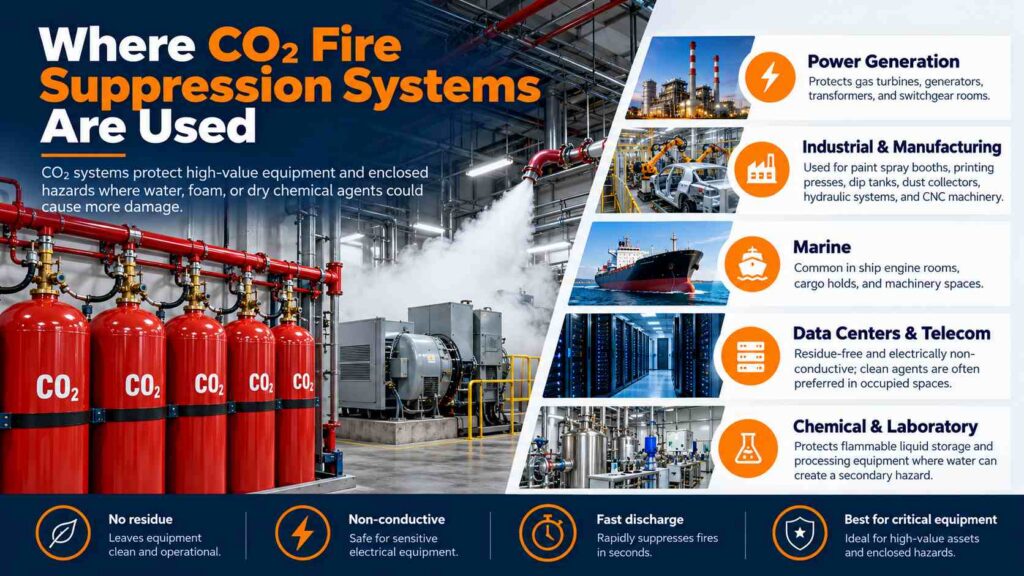
CO2 systems serve industries where water, foam, or dry chemical agents would destroy the protected equipment.
Power generation facilities use CO2 to protect gas turbines, generators, transformers, and switchgear rooms. CO2 suppresses fires without corroding turbine components or leaving residue inside precision machinery.
Industrial and manufacturing operations protect paint spray booths, printing presses, dip tanks, dust collectors, hydraulic systems, and CNC machinery. Any process involving flammable liquids, combustible dust, or high-heat equipment is a candidate.
Marine applications have used CO2 for decades. Ship engine rooms, cargo holds, and machinery spaces rely on CO2 because it performs well in enclosed metal compartments.
Data centers and telecom facilities need suppression that will not destroy what it protects. CO2 leaves no residue and is electrically non-conductive. That said, many occupied data centers now use clean agent systems because clean agents are safer for personnel.
Chemical and laboratory environments use CO2 to protect flammable liquid storage and processing equipment where water-based suppression creates a secondary hazard.
What Fire Classes Does CO2 Handle?
CO2 is effective on three of the five fire classes.
Class B fires involving flammable liquids and gases are the primary use case. Solvents, paints, oils, gasoline, and industrial chemicals all fall here. CO2 smothers these fires rapidly without spreading the burning liquid the way water can.
Class C fires involving energized electrical equipment are a natural fit because CO2 is electrically non-conductive. It will not short-circuit panels or create a shock hazard.
Class A fires involving ordinary combustibles like wood, paper, and textiles can be suppressed, but require significantly higher concentrations (65 to 75 percent) and longer hold times.
CO2 does not work on Class D fires involving combustible metals like magnesium or titanium. It also should not be used for Class K cooking oil fires, which require wet chemical systems.
Safety Requirements: What You Need to Know
This is the section that separates responsible fire protection contractors from companies that just want to sell equipment. CO2 is lethal at fire suppression concentrations, and anyone considering a CO2 system needs to understand that clearly.
At 34 percent concentration, the minimum design level for surface fires, CO2 causes unconsciousness and death within minutes. Above 17 percent, a person can lose consciousness in under a minute. The gas is colorless and odorless, so you cannot detect it by sight or smell.
The EPA has documented 62 incidents involving CO2 systems, resulting in 119 deaths and 152 injuries. Most occurred during maintenance or testing when workers bypassed safety procedures.
This does not mean CO2 systems are unsafe when properly designed. It means the safety engineering is just as important as the suppression engineering.
NFPA 12 Requirements
NFPA 12 is the governing standard for carbon dioxide extinguishing systems. It covers design, installation, testing, maintenance, and personnel safety. Key requirements include:
Pre-discharge alarms must activate before any automatic release, giving occupants time to evacuate. The system must include engineered time delays between alarm activation and discharge. Manual emergency stop stations must be located outside every entrance to the protected space. Doors must swing outward so discharge pressure does not trap anyone inside. Warning signs at every entry point must identify the system, its hazards, and emergency contacts. Forced ventilation must be available for post-discharge dispersal, and atmospheric testing with a calibrated oxygen monitor is required before re-entry.
OSHA classifies any atmosphere exceeding 4 percent CO2 as immediately dangerous to life or health (IDLH). Since every CO2 system operates well above that threshold, the full range of life safety controls applies.
CO2 vs Clean Agent Systems
The decision between CO2 and a clean agent system often comes down to one question: do people work in or regularly access the protected space?
Clean agents like FM-200 (HFC-227ea), Novec 1230, and inert gas blends (Inergen, Argonite) suppress fires at concentrations safe for human exposure. CO2 does not.
CO2 costs less per pound and is the only gaseous agent validated for local application. For unoccupied industrial spaces, marine engine rooms, and equipment enclosures, CO2 is often the better technical and financial choice. For occupied server rooms and control rooms, clean agents provide suppression without the life safety risk. FM-200 operates at 7 to 9 percent design concentration versus CO2 at 34 percent or higher.
In many facilities, both systems coexist. CO2 protects unmanned equipment rooms while clean agents protect occupied control spaces. Our engineered suppression team designs both and can help determine which approach fits your facility.
Inspection and Maintenance
A CO2 system that is not maintained is a liability, not a safeguard. NFPA 12 lays out specific inspection and testing requirements.
Annual inspections require weighing every CO2 cylinder. Any cylinder that has lost 10 percent or more of its charge must be refilled or replaced. Piping, nozzles, valves, and actuators get checked for corrosion, damage, and obstructions. Detection systems, alarms, interlocks, emergency stops, and warning signs all get tested.
Every five years, all cylinders must undergo hydrostatic testing. Failed cylinders are removed from service.
After any discharge, the entire system must be inspected and all cylinders recharged. Post-discharge atmospheric testing is required before re-entry. CO2 typically clears in 15 to 30 minutes depending on room size and ventilation, but never assume. Always test.
GMW Fire Protection provides fire suppression inspection and maintenance for CO2 and clean agent systems throughout Alaska.
Frequently Asked Questions
Is CO2 fire suppression dangerous to people? Yes. At suppression concentrations (34 percent and above), CO2 displaces enough oxygen to cause unconsciousness and death within minutes. Every CO2 system must include pre-discharge alarms, evacuation time delays, emergency stop stations, and restricted access protocols. The system is safe and effective when these life safety measures are properly designed and maintained.
What is the difference between CO2 and clean agent fire suppression? CO2 displaces oxygen and is lethal at design concentrations. Clean agents like FM-200 and Novec 1230 suppress fire through chemical interruption or heat absorption at concentrations safe for people. CO2 costs less and is the only option for local application. Clean agents are the choice for occupied spaces.
Does CO2 damage electronics or equipment? No. CO2 is electrically non-conductive and leaves zero residue. It will not damage servers, electrical panels, machinery, or sensitive instruments. This is one of the primary reasons it is used in data centers, power plants, and manufacturing environments.
What standard governs CO2 fire suppression systems? NFPA 12: Standard on Carbon Dioxide Extinguishing Systems. It covers system design, installation, testing, maintenance, and personnel safety requirements. OSHA regulations (29 CFR 1910.160 and 1910.162) also apply, requiring pre-discharge alarms for any system with a design concentration above 4 percent.
How often does a CO2 fire suppression system need inspection? NFPA 12 requires annual inspections that include cylinder weighing, detection testing, alarm verification, and safety control checks. Hydrostatic testing of cylinders is required every five years. Any discharge triggers a full system inspection and recharge before the system returns to service.
Can CO2 protect occupied spaces? Technically yes, but only with extensive safety measures including pre-discharge alarms, time delays, abort stations, restricted access, and atmospheric monitoring. Most facilities choose clean agent systems for regularly occupied spaces because they eliminate the life safety risk.
What fires can CO2 not suppress? CO2 is not effective on Class D fires involving combustible metals (magnesium, titanium, sodium) or Class K fires involving cooking oils and fats. It also cannot suppress fires in materials that contain their own oxygen source, such as cellulose nitrate.
How much does a CO2 fire suppression system cost? Installed costs typically range from $4 to $8 per square foot, with total project costs between $20,000 and $100,000 or more depending on system size, complexity, storage type, and alarm integration requirements.
To evaluate whether CO2 is the right fit for your facility, contact GMW Fire Protection at (907) 336-5000 or visit our contact page. We design, install, and maintain carbon dioxide suppression systems and clean agent systems across Alaska.