
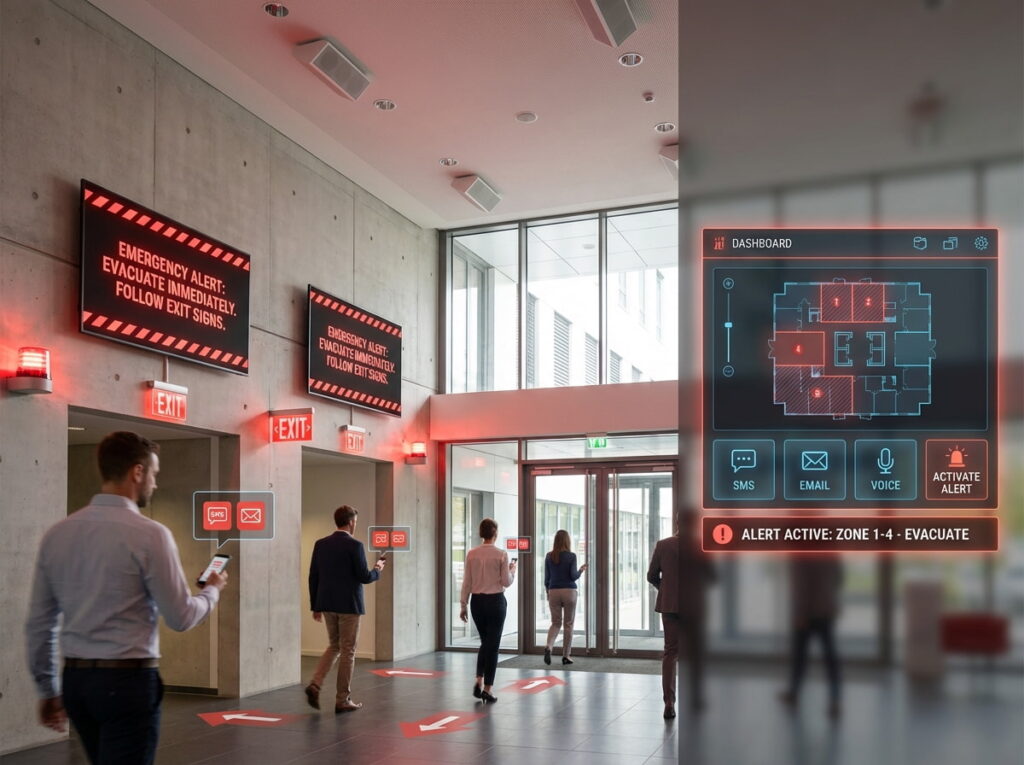
A mass notification system is a communication platform that sends urgent alerts to a large group of people all at the same time across multiple channels like text, voice calls, email, and building speakers. Think of it as a loudspeaker for the modern age: instead of one horn blaring in a hallway, your entire facility and every person in it gets the right message, on the right device, within seconds.
Whether you’re managing a school in Anchorage, a commercial facility in Fairbanks, or a government building anywhere in Alaska, a mass notification system can be the difference between a calm, controlled evacuation and a chaotic, dangerous one. Let’s break it all down, plain and simple.
Why Mass Notification Systems Matter More Than Ever
Here’s a scenario most building managers don’t want to think about: a fire breaks out in one wing of your facility while employees are scattered across three floors and two separate buildings outside. A fire alarm going off is helpful but does it tell people where the danger is? Does it tell them which exit to use? Does it reach the person working remotely who was just about to walk back into the building?
A traditional fire alarm says “something is wrong.” A mass notification system says exactly what is wrong, where it is, and what to do about it.
That’s a massive difference when lives are on the line.
Alaska’s unique geography makes this even more critical. Remote facilities, extreme weather events, and limited emergency response times mean you can’t afford to rely on outdated communication methods. You need a system that reaches everyone — fast.
What Does a Mass Notification System Actually Do?
At its core, a mass notification system does four things:
1. Sends alerts instantly and simultaneously
The moment an emergency is detected, whether by a fire alarm, a sensor, or a human operator, the system fires off alerts to everyone on the contact list at the same time. No waiting. No manual phone trees. No, hoping the right person is standing near the right speaker.
2. Reaches people across multiple channels
Modern MNS platforms send messages through SMS text, automated voice calls, email, desktop pop-ups, digital signage, social media, and building intercoms all at once. If someone misses the text, they’ll catch the voice call. If they’re away from their desk, they’ll get the SMS.
3. Targets the right people in the right areas
One of the most powerful features is geofencing, or geo-targeting. Instead of blasting an alert to every single person in your organization, the system can send warnings only to people in the affected building, floor, or zone. This keeps communication clear and prevents unnecessary panic.
4. Works two ways
This surprises a lot of people. Advanced mass notification systems don’t just send messages; they can receive responses too. Employees can confirm they’re safe. First responders can get real-time headcounts. Managers can account for every person in the building without running floor to floor.
Who Uses Mass Notification Systems?
You might be surprised by how many different types of organizations rely on these systems every day not just during emergencies, but for routine safety communications too.
Schools and Universities use MNS platforms to alert students, staff, and parents during lockdowns, severe weather events, or campus emergencies. If you’ve ever received a school text saying “there is an active situation on campus. Please shelter in place,” that was a mass notification system at work.
Government Agencies like FEMA use the federal IPAWS (Integrated Public Alert and Warning System) to push emergency alerts to entire regions. Those Wireless Emergency Alerts that buzz everyone’s phone during a tornado warning? Mass notification in action.
Businesses and Corporations use them to protect employees, coordinate emergency response, and maintain business continuity when critical events occur, whether that’s a fire, a chemical spill, or an IT security breach.
Healthcare Facilities rely on mass notification to coordinate staff during medical emergencies, equipment failures, or facility lockdowns, all without creating chaos in patient areas.
Industrial and Manufacturing Sites especially in remote Alaskan environments, use these systems to notify workers spread across large outdoor or multi-building properties.
How Mass Notification Systems Are Triggered
One of the smartest things about modern MNS platforms is their ability to operate automatically, without needing a person to push a button. Here’s how they can be triggered:
- Automatic integration: A fire alarm activation, smoke detector, or intrusion sensor can trigger the system instantly, with no human step required.
- Manual activation: An authorized user like a safety officer or building manager, can log into the platform and send an alert with a few clicks or even from a mobile app.
- Scheduled messages: For non-emergency communications (like a scheduled fire drill or building closure), messages can be set up in advance and automatically sent at the right time.
- Weather and public alert integration: Some systems connect to NOAA weather alerts or other public warning feeds and automatically relay them to your building occupants.
In Alaska especially, that weather integration feature is no small thing. When a severe storm or earthquake alert is issued, your building’s occupants should know about it immediately.
Mass Notification and NFPA Code Compliance
If you’re upgrading or installing a mass notification system in Alaska, it’s important to understand where the codes stand.
NFPA 72 — the National Fire Alarm and Signaling Code has dedicated chapters covering Emergency Communication Systems (ECS), which includes mass notification systems. Large facilities like high-rises, healthcare buildings, and government structures may be required by code to have an MNS in place.
Additionally, for the Department of Defense and certain federal facilities, UFC 4-021-01 sets specific standards for mass notification system design and installation.
At GMW Fire Protection, our team is fully versed in Alaska-specific code requirements and can help you understand what level of mass notification coverage your facility needs and make sure any installation meets those standards from day one.
The Bottom Line
A mass notification system is not a luxury or a nice-to-have feature. In today’s world, where threats range from fires and severe weather to security incidents and power failures, it’s a core part of any serious life safety strategy.
The right system reaches every person in your facility, on every device, through every available channel, in seconds. It works automatically when it needs to. It gives you accountability and data after the fact. And it integrates seamlessly with the fire alarm and safety systems you already have in place.
If you’re not sure whether your facility needs a mass notification system, or if you’re due for an inspection or upgrade, reach out to the GMW Fire Protection team today. We’re here to help you protect what matters most because fires never rest, and neither do we.