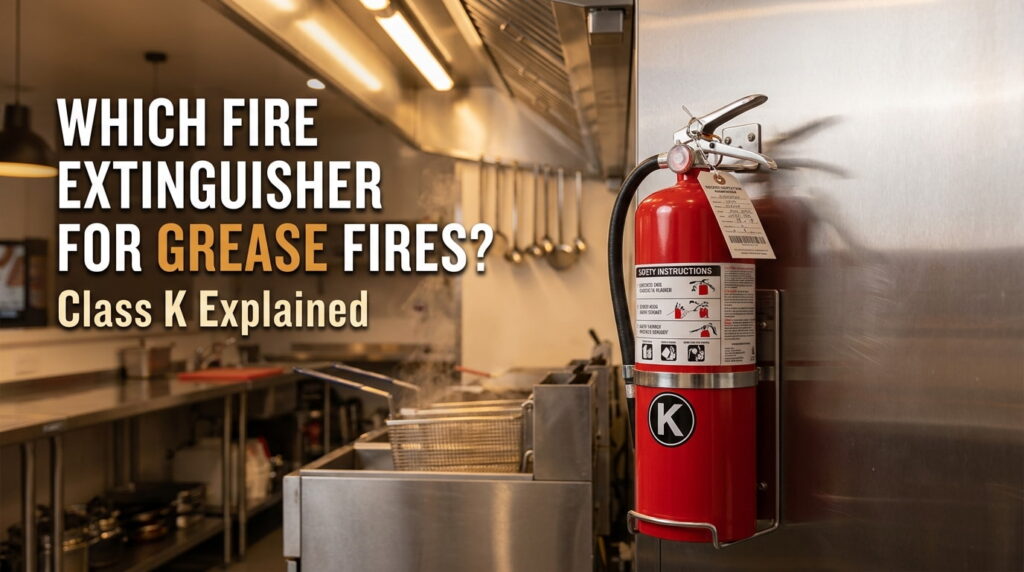
For grease fires, the correct fire extinguisher is Class K for commercial kitchens and a Class B or ABC for small grease fires at home. Class K is the only extinguisher specifically designed for the high-temperature cooking oils and fats used in deep fryers, grills, and commercial cookers, and it’s required by fire code for any restaurant or commercial kitchen. For home stovetop grease fires, a Class B or multi-purpose ABC extinguisher can work on small flare-ups, but the safest and easiest move at home is often to smother the fire with a metal lid or baking sheet before reaching for an extinguisher at all. After 26 years inspecting, installing, and servicing kitchen fire suppression systems across Alaska, GMW Fire Protection has seen what happens when the wrong extinguisher gets used on a grease fire, and the difference between Class K and the wrong choice can be the difference between a contained kitchen fire and a structure fire.
Here’s the focused answer you came for, with the details that actually matter for your kitchen.
Why Grease Fires Need a Special Extinguisher
Grease fires behave differently than wood, paper, or electrical fires. Cooking oils and fats burn at much higher temperatures than typical kitchen materials, often above 700°F. At those temperatures, water doesn’t put the fire out. Water sinks to the bottom of the hot oil, instantly vaporizes, and explosively throws burning oil out of the pan and across the kitchen. This is the fireball you’ve probably seen in viral videos of homeowners trying to put out a pan fire with water. It’s not exaggeration, it’s basic physics, and it sends people to the hospital every year.
Standard ABC dry chemical extinguishers have a different problem. The pressurized powder spray can scatter burning oil out of the pan, spreading the fire instead of containing it. On a small stovetop pan, that’s a contained mess. On a commercial deep fryer with gallons of hot oil, that’s a major fire incident.
This is the reason Class K extinguishers exist as a separate classification.
What a Class K Fire Extinguisher Actually Does
Class K extinguishers use a wet chemical agent, usually potassium acetate or a similar potassium-based solution. When the agent sprays onto burning oil, two things happen at once. First, the wet chemical reacts with the hot oil through a process called saponification, which creates a thick soapy foam on the surface of the oil. Second, the foam smothers the fire by cutting off oxygen and cooling the oil below its ignition temperature.
That soapy foam matters because it stays on top of the oil after the flames are out. Burning grease without that barrier can re-ignite as soon as it touches anything hot. Class K’s lingering foam prevents that re-ignition, which is exactly what you need in a commercial kitchen where surfaces stay hot long after the fire is out.
Class K is the standard for commercial deep fryers, char-broilers, griddles, woks, and any cooker that uses vegetable oil, animal fat, or shortening at high temperatures. NFPA 10 (the national fire code for portable extinguishers) requires Class K extinguishers in commercial kitchens, and they have to be inspected annually. NFPA 17A covers the wet chemical extinguishing systems built into commercial kitchen hoods.
What About Class B and ABC for Home Use?
For small home grease fires, the rules are different. Most home kitchens don’t have a Class K extinguisher because the cost (typically $200 to $400) and the size make them impractical for residential use.
A Class B extinguisher is rated for flammable liquids including small grease fires, and it works on a stovetop pan fire if you can stand close enough to use it. The downside is that most home Class B extinguishers use a dry chemical agent that can still scatter burning oil if you blast it from too close or at the wrong angle.
A multi-purpose ABC extinguisher (the kind most people already own) can also work on a small stovetop grease fire in a pinch, but with the same scatter risk. ABC is not officially rated for grease fires, but it’s better than nothing if a small fire is starting and you have no other option.
The honest recommendation for most homes is to not rely on either as your first defense. A heavy metal lid or a baking sheet placed over the burning pan is faster, safer, and doesn’t risk spreading the fire. Once the lid is on, turn off the burner and leave the lid in place until the pan is completely cool. We’ll cover that in the next section.
What Happens If You Use the Wrong Extinguisher
This is the part people skip and shouldn’t.
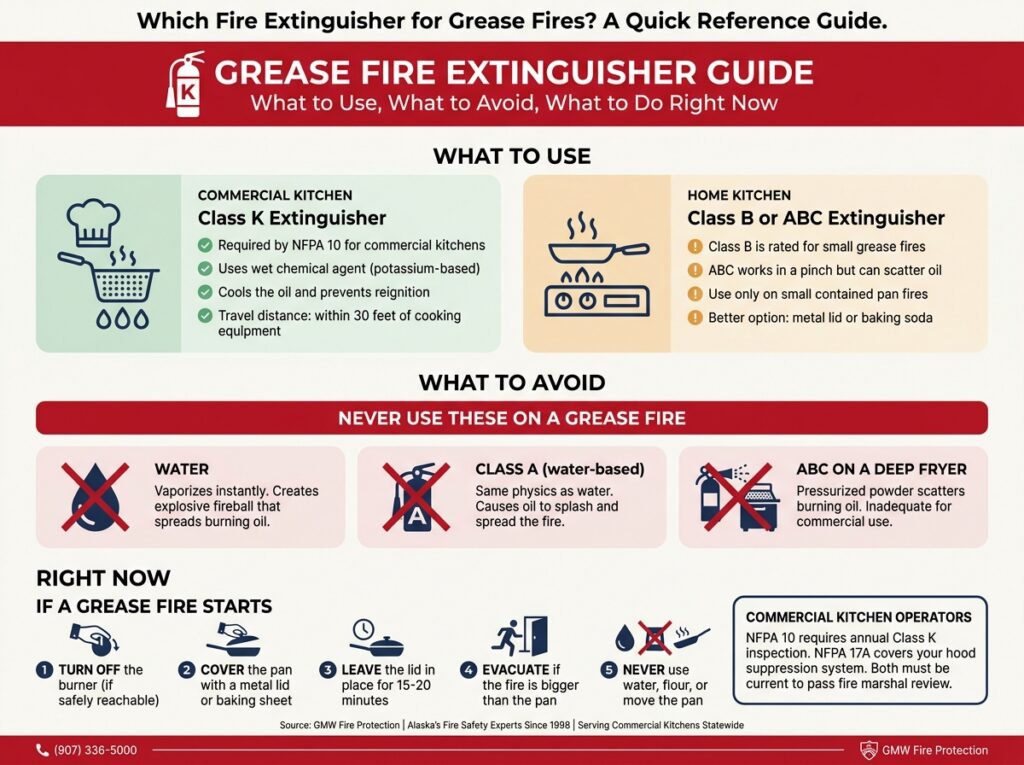
Water on a grease fire. Burning oil hits 700°F or higher. Water vaporizes instantly at 212°F. When water meets hot oil, the water expands into steam at about 1,600 times its liquid volume in a fraction of a second. That violent expansion launches burning oil out of the pan in all directions. In a home, this means burning oil on cabinets, on curtains, on the cook. In a commercial kitchen with a deep fryer, this means a fireball that can ignite the hood and ceiling.
Class A (water-based) on grease. Same physics, same result. Class A extinguishers are essentially pressurized water and they create the same explosive vaporization on hot oil.
Standard ABC dry chemical on a commercial deep fryer. The pressurized powder spray can splash burning oil out of the fryer onto adjacent surfaces. It may put the surface fire out temporarily, but it doesn’t cool the oil, and re-ignition is likely. This is why NFPA 10 requires Class K specifically for commercial cooking equipment, not just any extinguisher.
Class C (electrical) on grease. Wrong class entirely. Class C is for energized electrical fires. Using it on grease doesn’t address the actual fire type and wastes critical time.
The pattern is consistent. The wrong extinguisher on a grease fire makes the situation worse, not better. Knowing the right class before you need it is the whole point.
What to Keep in a Home Kitchen
For most Alaska homes, here’s the practical recommendation. Keep a heavy metal pan lid or baking sheet within arm’s reach of the stove. Keep a box of baking soda nearby (baking soda can smother small grease flames by releasing carbon dioxide). And keep one multi-purpose ABC extinguisher mounted in the kitchen but not directly above the stove, where you’d have to reach over flames to grab it.
If you want better protection, a small Class B extinguisher rated for cooking fires can be added. Some manufacturers now sell home-sized “kitchen fire extinguishers” that are essentially Class B with a wet chemical formulation similar to commercial Class K. These run $50 to $150 and are worth considering if you cook frequently with oil.
What’s Required in a Commercial Kitchen
Restaurants, lodges, cafeterias, food trucks, school kitchens, and any commercial cooking operation have different rules.
NFPA 10 requires that all commercial kitchens with cooking equipment using combustible cooking media (vegetable oils, animal fats, shortening) have at least one Class K extinguisher accessible within a 30-foot travel distance from the cooking equipment. The extinguisher has to be inspected monthly by staff and serviced annually by a certified fire protection professional.
In addition, most commercial kitchens with deep fryers or large cooking appliances are required to have a wet chemical extinguishing system installed in the hood, covered under NFPA 17A. This is the system that automatically discharges if a fire is detected in the cooking area. The portable Class K extinguisher is the backup, not the primary defense.
Local Alaska fire marshals in Anchorage, Fairbanks, Mat-Su, and across the state generally follow NFPA standards. We’ve serviced commercial kitchens from downtown Anchorage restaurants to lodge kitchens on the Kenai Peninsula to oilfield camp kitchens on the North Slope, and the Class K requirement is consistent. If you operate a commercial kitchen and you’re not sure whether your extinguishers are properly classified and current on inspection, that’s worth checking before your next fire marshal visit.
What to Do RIGHT NOW If a Grease Fire Starts
A short, focused checklist for the moment a small grease fire happens at home.
Turn off the burner immediately if you can safely reach the knob. Do not reach over the flames.
Cover the pan completely with a metal lid or baking sheet. The fire needs oxygen, and the lid cuts it off. Slide the lid on from the side rather than dropping it from above to avoid splashing oil.
Leave the lid in place. Do not lift it to check. Lifting reintroduces oxygen and the fire can reignite. Wait at least 15 to 20 minutes for the oil to fully cool.
If the fire is bigger than the pan or starting to spread, get out of the house and call 911. Do not try to be a hero with a fire growing past the cooking surface.
If you do not have a lid available and you have an extinguisher within reach, use Class B or ABC if that’s what you have. Stand 8 feet back, aim at the base of the fire, and use short controlled bursts.
Never use water. Never use flour. Never try to move a burning pan.
Bottom Line
The answer to “which class of fire extinguisher is used for grease fires” is Class K for commercial kitchens, Class B or ABC for small home situations, and a metal lid is often your safest first move at home regardless. The wrong choice on a grease fire doesn’t just fail to put it out, it actively makes the fire worse and puts people at risk.
If you operate a commercial kitchen anywhere in Alaska and you’re not 100 percent sure your Class K extinguishers and hood suppression systems are properly inspected and current, get them looked at. Annual inspection is required by code, and the alternative is a fire incident plus a code violation.
Frequently Asked Questions
Can I use a regular ABC fire extinguisher on a grease fire?
For a small stovetop grease fire at home, yes, but with caution. ABC dry chemical can scatter burning oil if you spray too close or at the wrong angle. Stand 8 feet back and use short bursts at the base of the flames. For any commercial cooking equipment or larger grease fire, ABC is not adequate. Class K is required.
Why can’t I use water on a grease fire?
Burning oil is hotter than the boiling point of water. When water hits hot oil, it instantly vaporizes and expands more than 1,500 times in volume, which launches burning oil out of the pan in all directions. This causes a fireball, severe burn injuries, and rapid spread of the fire to nearby surfaces.
Do home kitchens need a Class K fire extinguisher?
Not legally. Class K extinguishers are required for commercial kitchens under NFPA 10. Home kitchens are not required to have one. A heavy metal lid, baking soda, and a multi-purpose ABC extinguisher are usually sufficient for home use. Some homes that do a lot of deep frying or have wok stations may benefit from a small Class B extinguisher rated for cooking fires.
How often do Class K extinguishers need to be inspected?
NFPA 10 requires Class K extinguishers to be visually inspected monthly by trained staff and serviced annually by a certified fire protection professional. Hydrostatic testing is required every 5 years for most wet chemical extinguishers. If you operate a commercial kitchen, the annual inspection has to be documented and the extinguisher tagged with the inspection date.
What’s the difference between a Class K extinguisher and a kitchen hood suppression system?
A Class K portable extinguisher is the manual backup that staff use on a contained fire. A kitchen hood suppression system (covered under NFPA 17A) is the automatic system mounted above the cooking equipment that discharges wet chemical agent automatically when a fire is detected. Most commercial kitchens are required to have both. The hood system is the primary defense and the portable Class K is the secondary.