


Your fire alarm went off at 3 a.m. for the same reason it does in most homes: a weakening battery dropped just below its safe voltage as the room cooled overnight. That’s it. Not a fire, not a ghost, not a broken alarm. Just simple physics, and it happens to thousands of people every single night. After 26 years of fielding these calls across Alaska, GMW Fire Protection can tell you the cold is almost always behind the nighttime chirp. The other usual suspects are dust, steam, bugs, and old age, and we’ll get to all of them. But first, the part nobody tells you.
The Cold Battery Story Nobody Explains Properly
Here’s what’s really going on inside your alarm.
A 9-volt battery doesn’t just slowly die. Its internal resistance climbs as it ages. When the room gets cold, that resistance climbs a little more. If the battery is already on its last legs, that extra bit of cold-induced resistance is enough to push the voltage below what the alarm needs to run, and the alarm sounds the low-battery warning to tell you so.
Homes are coldest between roughly 2 and 6 in the morning. That’s the window where the temperature dip lines up with a weakening battery, and that’s why so many people wake up at the same time night after night. By breakfast, the house has warmed up a couple degrees, the battery recovers a little, and the chirp stops. People think the alarm “fixed itself.” It didn’t. The battery is still failing, and tomorrow night you’ll hear it again.
This effect is worse in Alaska than almost anywhere else in the country. Long, deep cold. Drafty older homes. Cabins that sit half-heated. We see it constantly from October through April.
Fire Alarm Beeping vs Chirping: What Each Sound Means
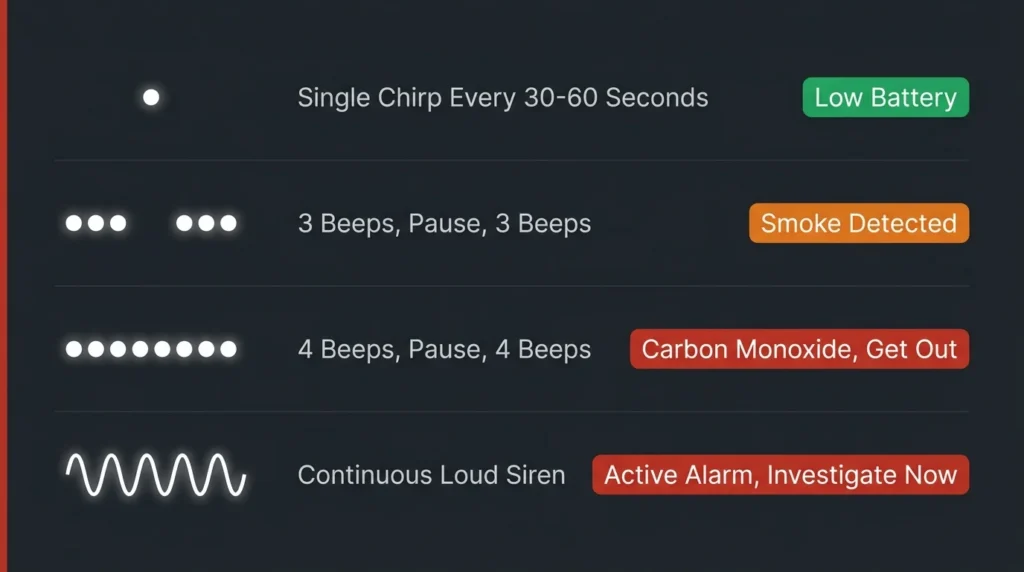
Pay attention to the pattern, because the alarm is trying to tell you something specific. Getting this wrong can mean ignoring a real emergency or losing sleep over nothing.
Chirping is a short, single beep every 30 to 60 seconds. That’s the low-battery warning. Annoying, not dangerous. It means your battery is dying, not that there’s a fire. This is the sound that wakes people up at 3 a.m.
Continuous beeping or a loud siren is the actual smoke alarm doing its job. You need to investigate immediately. Do not assume it’s a false alarm until you’ve checked every room.
Three loud beeps, pause, three more beeps is the standard smoke pattern established by NFPA. Your alarm detected smoke or particles in the air.
Four beeps in a row is carbon monoxide, which is a whole different problem. Get everyone outside and call 911 from the driveway. Do not re-enter the house until a professional clears it. GMW covers the difference between smoke alarms and CO detectors in a separate guide.
If you can’t tell which sound you heard because you were half asleep, treat it as real until you’ve checked the house.
Ionization vs Photoelectric: Why Your Alarm Type Matters
Not all smoke detectors work the same way, and the type you have affects how easily it false alarms at night.
Photoelectric alarms shine a small light beam across an internal sensing chamber. When smoke or particles scatter that beam, the sensor picks up the scattered light and triggers the alarm. These are better at detecting slow, smoldering fires but are also sensitive to dust, steam, and humidity, which is why they trip more easily near bathrooms and kitchens.
Ionization alarms use a tiny amount of radioactive material to ionize the air inside the chamber. When smoke enters, it disrupts the ion flow and triggers the alarm. These respond faster to fast-flaming fires but are more prone to false alarms from cooking smoke and fine particles. According to the U.S. Fire Administration, both types are acceptable, but combination alarms that use both technologies provide the most reliable protection.
If you’re getting frequent false alarms, check which type you have. It’s printed on the back of the unit. If you have ionization alarms near a kitchen or bathroom, that placement alone could explain most of your nighttime trips.
The Other Reasons Alarms Trip at Night

Battery is the biggest one, but not the only one. Here’s the rest of the list in the order we see them on actual service calls.
Dust inside the sensor. Smoke detectors work by detecting particles in the air. Dust does the job just as well as smoke. So does cobweb. So does the fine drywall powder left over from a remodel two years ago. If you’ve never cleaned your alarms, this is probably your problem.
Steam from a late shower or a kettle. Water vapor is dense enough to fool the sensor into thinking it’s smoke, especially if the alarm sits near a bathroom door. If someone in the house showered around midnight and the alarm went off forty minutes later, that’s almost certainly your cause.
Bugs. We’ve pulled spiders, tiny moths, and once an entire wasp out of smoke detectors. They crawl in through the side vents, get stuck, and either block the light beam or trip the sensor with their movement. Common in cabins. Common in rooms that don’t get used much.
A sudden temperature shift. Your furnace kicks on at 4 a.m. Cold draft pushes warm air across the ceiling. Dust gets stirred. The alarm trips. Same thing happens when a window gets opened in winter.
Old age. Smoke alarms aren’t lifetime appliances. The Consumer Product Safety Commission recommends replacing them every 10 years because the sensor itself starts drifting. After ten years, false alarms become more frequent and, more importantly, the alarm becomes less reliable in a real fire. Flip yours over. There’s a date stamped on the back. If it’s older than a decade, replace it. Don’t argue with it, don’t troubleshoot it, just replace it.
Hardwired electrical issues. If your alarms are wired into your house power and one trips for no reason, the cause might not be in the alarm at all. Brief power dips, a loose connection in the daisy chain, or a surge from a nearby appliance can confuse the whole loop and make every alarm in the house sound at once. This one usually needs a professional.
And the one nobody wants to think about: an actual early sign of fire. Electrical fires inside walls smolder for a long time before they break out. Overheating appliances and old wiring give off small amounts of smoke that you might not see or smell. Always walk the house before assuming the alarm was wrong.
What to Do When It Goes Off Tonight
Don’t pull the battery. We say it every time we go on a service call, and people still do it. According to NFPA research, a disabled alarm is the leading cause of fire deaths in homes that had alarms installed. Don’t be that statistic.
Here’s the routine instead.
Get everyone up and do a quick walk through the house. Smoke, smell, warm doors, anything unusual in the kitchen, furnace room, or laundry area. If anything looks even slightly wrong, get out and call 911 from the driveway.
If the house is fine, open a window for a minute to clear the air. Steam and humidity hang around longer than people realize.
Find the alarm that started it. In a hardwired interconnected system, every alarm in the house will be sounding, but only one will have a rapidly flashing red light. That’s the one that detected the problem. The others are just repeating its signal. Focus there.
Press the hush or silence button. Most alarms will go quiet for eight to ten minutes while you figure out what’s going on. If pressing it does nothing, you’re going to need to pull the unit down.
Battery-Powered Alarms: How to Reset
Twist the alarm counterclockwise to take it off the ceiling. Open the battery door. Take the battery out. Wait thirty seconds. While you’re there, look at the metal contacts inside. If you see any grime or green corrosion, wipe it with a dry cloth.
Now put in a fresh battery. Not one from the drawer that’s been there since 2022. A new one from a sealed pack. Press the test button. You should hear one strong, clean beep. Put the alarm back on the base.
If it chirps again with a brand new battery, look at the manufacture date on the back. Over ten years old? Replace the whole unit. They’re twenty bucks at the hardware store.
Hardwired Alarms: How to Reset
This one’s a bit more involved because hardwired alarms have a backup battery that keeps them sounding even when you cut the power.
Go to your electrical panel. Find the breaker labeled “smoke alarms” or something similar. Flip it off.
Now take down the alarm with the fast-flashing red light. There’s a small wiring harness plugged into the back. Disconnect it. Pull out the backup battery too.
Leave the whole thing disconnected for at least one full minute. This is the part most people skip, and it matters. The system needs time to fully clear.
Pop in a fresh backup battery, plug the harness back in, reattach the alarm, flip the breaker back on. Hit the test button to confirm it’s working.
If it still trips after a full reset, something in the system is failing. Could be the unit itself. Could be a wiring problem. Either way, that’s the point where you call a fire alarm company instead of spending another sleepless night on it.
How to Stop False Fire Alarms for Good
Most false alarms are preventable. These are the maintenance habits that eliminate them.
Clean your alarms twice a year. A vacuum with the brush attachment, run gently around the side vents, takes about thirty seconds per unit. That one habit will knock out most dust-related trips.
Replace batteries once a year. Don’t wait for the chirp. Pick a date you’ll remember. Many fire departments recommend swapping batteries when you change your clocks.
Replace the entire unit every 10 years. Not optional. The sensor degrades regardless of how clean you keep it. Check the manufacture date on the back.
Fix placement problems. Alarms within 10 feet of a kitchen, bathroom, or garage door are going to false alarm. Move them to the nearest hallway instead. Keep them at least 3 feet from any air vent or ceiling fan.
Get a professional fire alarm inspection annually. Especially for hardwired systems where wiring issues can cascade across every alarm in the house. A technician can spot failing components before they wake you up at 3 a.m.
Alaska Homes Get This More Than Most
We get nighttime alarm calls year-round, but they spike from late October through March. Reasons are pretty specific to up here.
The cold dips are deeper, so battery voltage drops hit harder. Wood stoves and oil heat throw fine particles that settle inside sensors over the winter. Cabins sit empty for weeks, which lets dust and bugs collect. Tight modern homes hold humidity longer because nobody wants to open a window when it’s negative twenty outside. And homes in Fairbanks and the Interior often run lower nighttime temperatures than homes down in Anchorage, which means worse battery performance overall.
If you live up here, plan on cleaning your alarms twice a year instead of once. That one habit will eliminate most of the nuisance alarms you’d otherwise deal with.
A Word for Business Owners
If you manage a commercial building and your fire alarm trips at 3 a.m., this is not a “deal with it tomorrow” problem.
Most commercial fire alarm systems are monitored, which means the signal goes straight to a central station, and from there to the fire department. A false alarm at a business can mean a full engine response, possible false alarm fines from the municipality, disrupted operations, and an awkward phone call from your insurance carrier. In Anchorage and Fairbanks both, repeat false alarms can hit you with escalating penalties.
Commercial systems are also held to NFPA 72 and local fire code, which means a documented nuisance alarm has to be investigated and resolved on paper, not just silenced. A repeating false alarm usually points to a real problem: a failing initiating device, a dirty duct detector, a panel that needs reprogramming, or a sensor that’s been compromised by construction dust. None of those will fix themselves.
Call your monitoring company, document the time and the alarm that tripped, and get a licensed fire alarm technician out to inspect the system. Don’t let it slide until your next annual inspection.
Bottom Line
Your alarm didn’t malfunction. It told you something. Most of the time it’s a tired battery reacting to a cold night, and the fix takes five minutes. Sometimes it’s dust. Sometimes it’s a bug. Sometimes, rarely, it’s a real warning.
Don’t disable it. Investigate it. A working smoke alarm cuts your risk of dying in a home fire by about half, which is the whole reason it’s on your ceiling in the first place. Lose sleep one night, fix the problem, and sleep easy the rest of the year.
Frequently Asked Questions
Can extreme cold actually damage a smoke alarm?
Yes. Most residential alarms are rated to work between about 40 and 100 degrees Fahrenheit. Unheated garages, entryways, and seasonal cabins regularly drop below that, and the sensor either gives false readings or stops working. Those spaces need heat detectors, not standard smoke alarms.
Is it safe to just remove the battery and deal with it in the morning?
No. A disabled alarm is the single biggest reason fires turn fatal in homes that supposedly had protection. Use the hush button to silence it for ten minutes while you check things, then replace the battery before you go back to bed. Not tomorrow.
How often should I be cleaning my smoke detectors?
Once a year for the average home. Twice a year if you have pets, run a wood stove, live in a dusty area, or own a cabin. Quick pass with a vacuum brush around the vents, takes thirty seconds. Skip this and you’ll be back to dealing with false alarms.
My alarm chirps even with a fresh battery. What now?
Two things to check. First, is the battery genuinely new, from a sealed pack? Batteries lose charge sitting in a drawer. Second, look at the date on the back of the unit. Older than ten years means the alarm is at end of life and needs to be replaced, not repaired. No amount of new batteries fixes an expired sensor.
Can cooking set off a fire alarm?
Yes, and it’s one of the most common causes. Cooking smoke, burnt toast, and even steam from boiling water can trip a smoke detector, especially ionization-type alarms. If your kitchen alarm goes off regularly while cooking, it’s probably too close to the stove. Move it to the nearest hallway at least 10 feet away, or switch to a photoelectric alarm that’s less sensitive to cooking fumes.
How do I stop my smoke detector from beeping every 30 seconds?
That 30-second chirp is the low-battery signal. Replace the battery with a fresh one from a sealed pack and it should stop immediately. If the chirping continues with a new battery, the alarm itself has reached end of life and needs full replacement. On hardwired systems, you may also need to reset the breaker after swapping the backup battery. Our guide above walks through the full reset process for both battery and hardwired alarms.
Last updated September 2026.