
Fire extinguisher labels use letters, shapes, and pictograms to tell you which fires they can safely fight. Each letter – A, B, C, D, or K – corresponds to a fire class (type of fuel). The colored shape around the letter helps you spot it quickly (for example, a green triangle for Class A, a red square for Class B, etc.). In short, these symbols are a quick visual guide: they identify the kinds of fires (wood/paper, grease, electricity, metals, cooking oils, etc.) that the extinguisher is designed to handle. (Using the wrong type can make a fire worse – for example, never use a water extinguisher on a grease fire.) Below we break down each class and what its symbol means.
Fire Classes and Their Symbols
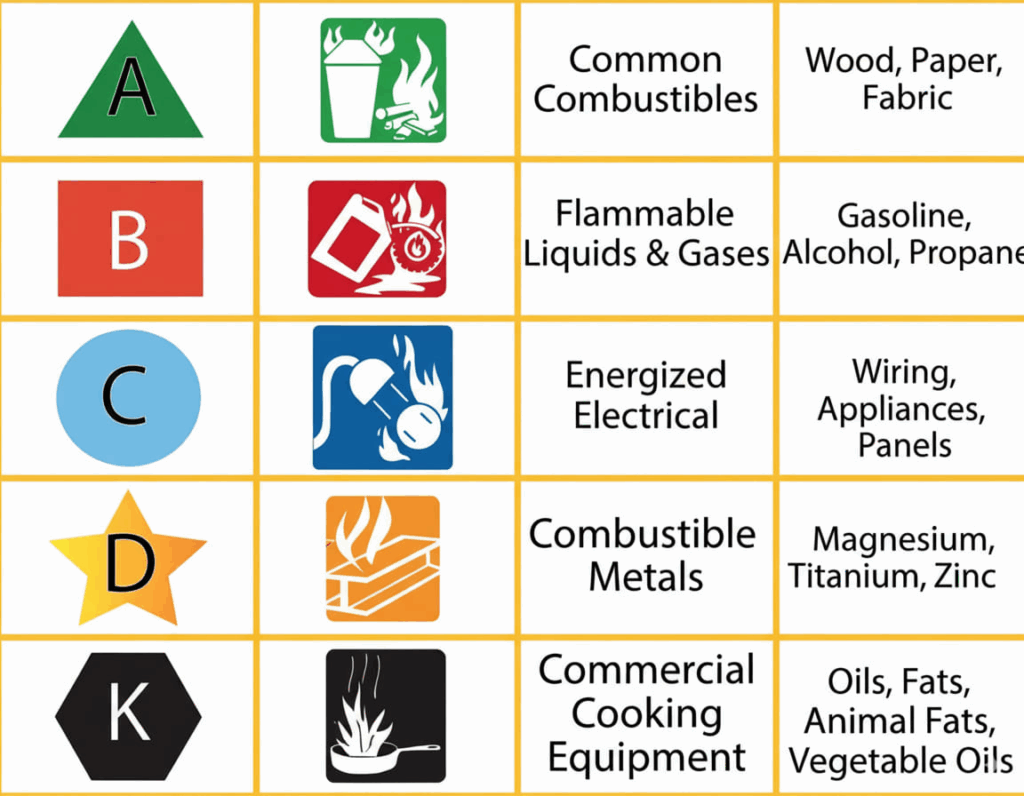
- Class A (Green Triangle) – Ordinary combustibles like wood, paper, cloth, and many plastics. The symbol is a green triangle with an “A”. (You’ll often also see a little trash-can or burning logs pictogram.) Use a water or dry-chemical extinguisher for Class A fires, and look for that green-triangle A label.
- Class B (Red Square) – Flammable liquids and gases such as gasoline, oil, grease, and solvents. This symbol is a red square with a “B”. You might see a small fuel-can pictogram with it. Class B fires need a foam, CO₂, or dry chemical extinguisher – never water, as it can spread the flames.
- Class C (Blue Circle) – Electrical or “energized” equipment fires (electronics, wiring, outlets, etc.). Marked with a blue circle and a “C”. (Often shown with a lightning bolt or plug icon.) Class C extinguishers use nonconductive agents (like CO₂ or dry chemical) so you don’t risk electric shock. Importantly, Class C doesn’t have its own number rating – it just means “safe for electrical fires” on top of the A/B rating.
- Class D (Yellow Star) – Combustible metal fires (magnesium, titanium, sodium, etc.), which are rare and occur mainly in labs or factories. The symbol is a yellow star (or sometimes a decagon) with a “D”. (You may see a burning metal beam pictogram.) Class D fires require special dry powder extinguishers designed for metal fires. They also have no numerical rating – they’re only for specific metal fuels.
- Class K (Black Hexagon) – Kitchen fires involving cooking oils, fats, and grease (deep fryers, for example). The symbol is a black hexagon with a “K”. (Often shown with a frying-pan icon.) Class K extinguishers contain a wet-chemical agent that creates a soap-like layer to cool and smother grease fires. Like Class C, Class K shows just the letter (no number) because kitchen fire hazards vary so much.
Each symbol is standardized, so you can memorize it for safety. For example, government and safety guides all agree: Green triangle = Class A (wood/paper), Red square = Class B (liquids), Blue circle = Class C (electric), Yellow star = Class D (metals), Black hexagon = Class K (cooking oils). In practice, extinguishers often use both the letter and a small picture (trash can, fuel can, lightning bolt, metal, frying pan) to be extra clear.
Multi-Class Extinguishers and Ratings
Many modern extinguishers are multi-purpose – they’ll have more than one class symbol on the label (e.g. “ABC” or “BC”). These symbols appear side-by-side, indicating the extinguisher works on all those fire types. For instance, an ABC extinguisher can tackle ordinary combustibles, flammable liquids, and electrical fires (so you’d see A, B, and C icons together). As NFPA guidelines note, multi-class extinguishers simply list each applicable symbol in a row. This makes it quick in an emergency: you just match the fire (A vs B vs C, etc.) to one of the symbols on the extinguisher.
The number ratings on the label (like “2A” or “10B”) tell you the size or power of the extinguisher. For Class A, each “unit” equals 1.25 gallons of water equivalent. For example, an 8-A extinguisher fights fires as well as 10 gallons of water (8 × 1.25). For Class B, the number equals the area of flammable liquid fire it can cover (in square feet). So a 10-B rating means it can handle 10 ft² of a gasoline-like fire. In short, bigger numbers mean more extinguishing ability. (You’ll never see numbers before C or K – those classes simply use the letter to show safety, because you don’t measure them by gallons or square feet.)
Using Symbols to Stay Safe
Understanding these symbols is crucial for safety. In a panic, you don’t want to be guessing: the label’s letters and icons instantly tell you if an extinguisher is right for the fire. For example, the blue “C” circle reassures you it’s safe on electrical fires, so you won’t mistakenly use a water-based one and get shocked. Likewise, spotting a red square means “flammable liquids” at a glance. Remember: using the wrong extinguisher can be dangerous (water on grease, CO₂ on metals, etc.).
Before you use an extinguisher, always check its label symbols and ratings. Make sure the fire’s class (A, B, C, D, or K) is covered by the extinguisher’s symbols. If the symbols don’t include that class, don’t use it. And of course, if a fire is too big or unsafe, evacuate and call the fire department. But in small fires, grabbing the right extinguisher quickly – by matching these symbols – can save lives and property.